Latest Article Get our latest posts by subscribing this site

Instinctive Composition

One of the most interesting and puzzling questions about music composition is whether it is instinctive or planned. A great deal of what we do in music is rehearsed in meticulous detail. As a visual analog to this, just look at the dancing in a recent music video:


Every detail is precisely calculated in both the dance and the song itself. But of course there was inspiration as well in the original kernel of the idea of the song, "single ladies" and in the decisions about the bare synthesized arrangement. But once these few creative choices were made, the rest was largely execution.

I'm writing about this because of an interesting comment left on my post "Long Lines of Winter Light", which was about a piece of mine for guitar orchestra. The commentor mentioned a fondness for "instinctive" music, which my piece certainly was. I can't trace how I wrote it (it was quite a few years ago), but I do know it was not planned out. I just had the idea of writing a lot of short little ideas, putting them in boxes and arranging them like a flow chart. The most planned part was how I conducted it because I rehearsed the orchestra in different ways until I found a way of organizing the piece that was musically satisfying. The score for that piece is just a box of tools that you can use to create a piece.

But the instinctive way doesn't always work. I probably have boxes and piles of instinctive scribblings that never gelled into a piece. Out of five pieces I write, or start to write, probably four are failures. I keep them, in case a little idea or motif can prove useful in some other context.

So that's me. What about other composers? A lot of them, like Stravinsky, either don't reveal much, or lie a lot about what they do. Others, like Bartók, are pretty clear about what they were doing. In his case, the influence of folk song and some mathematical ideas like the Fibonacci sequence are traceable in how he structures a piece. Others, like Schoenberg in his later music, are all too planned out. The 12-tone method is really a way of achieving theoretical unity through intense planning. His early music seems to be instinctive, but one cannot be sure...

Beethoven's way of working is one of the most interesting. He sketched and sketched and worked on and hammered out themes for years sometimes. There are whole books written about Beethoven's sketchbooks--many of which have been preserved. Here is a little sample:
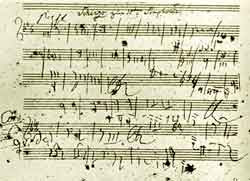

When I do this, it usually results in a turgid mess. But it worked for Beethoven. Somehow, he could work on a piece exhaustively without it sounding belabored. Most of my music is better if I don't over-work it. I was reading about a composer who seems to represent the opposite extreme from Beethoven: he simply writes and writes and writes, never going back and never correcting. Apart from recalling he was English, I can't remember the composer's name.

Let's listen to some music by Beethoven. His Diabelli variations were written in two sessions, first in the spring of 1819. But then he ceased work on them in early 1820 and only picked them up again in mid-1822. They were finished in 1823. Again, whole books have been written on this piece of music and the process of composition. Here are the Diabelli Variations: one hour of simply terrifyingly brilliant music performed by the great Grigory Sokolov:


Mozart, on the other hand, just seemed to write down perfect music as if angels were dictating to him...


Townsend: Long Lines of Winter Light

Way back in September 2011 I put up a post called "History of a Composition" that discussed a piece I wrote for guitar orchestra. I have just come across a recording of that piece so I have prepared a clip of it. The original inspiration was simple need: I had a large guitar ensemble and it was so difficult getting them to play exactly together that I thought I would write a piece where they never had to!

I knew about "moment form" so I wrote a piece called "Forms" that consisted of a series of boxes arranged like a flowchart. You started at the top and followed the lines. There were ten numbered levels so you could just go through playing each level in sequence. Most levels had options: you could choose from three or four different musical ideas. Since I conducted the piece, that allowed me to make choices as well. By signaling I could tell specific players to play specific levels. For example, the first level is a snare-drum effect. By crossing the two lowest strings over one another and strumming, you can make the guitar sound a lot like a snare drum. What I liked to do was to recall this level later on in the piece, so it sounds like chaos is going to overcome. Of course, every performance will be different, but the conductor can shape how it unfolds in various ways. The score is like a toolbox for building a piece and the conductor--with the players--can build a different piece every time.

About the title: as I said, the original title was just "Forms". I had an inspiration one day walking by the ocean and looking at the late afternoon light shining on the Sooke hills. Sooke is a village and adjacent wilderness area near Victoria, British Columbia, on Vancouver Island. My idea was a piece for "string quartet" of mandolin, banjo, guitar and double bass and the title that came to mind was "Long Lines of Winter Light Falling Gently Across the Sooke Hills"! Well, I never got around to writing that piece, so I appropriated the title for this piece.

A few years ago a Swedish publisher put out an edition of three pieces of mine for guitar orchestra which included this piece. On the clip I have the front cover of the publication, the two pages of the score of this piece and three pictures of the Sooke hills. Oh, and a photo of me about the time I wrote this piece. Here it is:


Magical Transformations

There are certain musical phenomena that are very, to my ears, evident, but are scarcely ever talked about. It is like we all have this secret we know but that we never mention. I'm talking about what I call "magical transformations". These are kinds of aesthetic musical journeys or transformations that are inherent in the very nature of music, but that only appear occasionally, as if by magic. One of them is in a piece I was just recently talking about, the first movement of the Symphony No. 7 by Shostakovich in which, over eleven minutes, a simple march tune is transformed from a jaunty little nothing into a ravening monster that terrifies the listener. Of course, he had to use all the resources of a large orchestra to do that. But there are other, equally magical transformations accomplished with very modest musical resources. One remarkable one happens in a recording of a blues tune by Robert Johnson. This is Eric Clapton with some of the best session players around. For one thing, Billy Preston is on organ. The only two outside people to ever play with the Beatles--in the band, not just a little solo added on--were Billy Preston on Abbey Road and Eric Clapton on The White Album (without credit). But all these musicians are top notch. Now listen:


You might notice that it starts off pretty laid back. Everyone is playing well, clean, but without much excitement. This was probably the first tune of the session. The song trudges along until the four minute mark when Clapton takes a solo that extends to the five minute mark. Whatever he did during that solo absolutely transforms this band from a bunch of guys who know how to play the notes, to a bunch of guys who are really excited to be playing the notes. From the five minute mark to the end, they sound like an entirely different band. What did Eric do? Magic. And by that I mean he chose notes and expression and vibrato and a thousand other things in his solo to communicate an intense musical expression that the rest of the guys responded to. Eric Clapton is rarely on stage with anyone even close to being his musical equal and this shows it. When he is, as he was with Cream, some magical things can happen. A few years ago Cream got together for a few concerts in Royal Albert Hall and this is one of the tunes that they played. It's an old blues tune by Skip James. For the first three minutes it's just an ordinary song, delivered pretty well, but nothing special. Then at the three minute mark, they launch into one of their famous group improvisations and within a mere 45 seconds, they are soaring into the stratosphere. Again, Clapton is the catalyst, but Jack Bruce and Ginger Baker are right there with him all the way. Have a listen and see what I mean.


Here is an utterly different kind of magical transformation. The fifth movement of Beethoven's Quartet op 130 in B flat, is a Cavatina. For the first four minutes it is a profound, touching, deeply sad piece that few if any other composers could have written. But then, at the 4:14 mark in this recording, it becomes something utterly different. The accompaniment goes into throbbing triplets and the violin plays something that seems almost hopeful, but somehow it is hope that can only be crushed. I don't really know how to put it into words. This transformation I think no other composer could accomplish...


So there you have four different kinds of magical transformations. I say magical because, while we might be able to put into words or theoretical analysis, some of the techniques involved, I don't think we can really capture what is going on. I also think it is something that does not necessarily happen in every performance, just ones where the musicians are either very sensitive, or very lucky. And I really don't think we can put into words the feeling the listener has, hearing the transformation.

Anybody have any other examples?

The Autobiographical Fallacy

We don't know where music comes from. We speculate all the time and we keep trying to tack it down, but we never really succeed. Personally, I'm grateful for that. But one of the things that came out of the Romantic era that still seems to be with us, is the idea that music is like an autobiography of the composer. Even though Mozart wrote some of his most cheerful music at the lowest points of his life and Schumann wrote some of his most deeply melancholy music when he was at his most happy, in the fulfillment of his long-delayed marriage to Clara Wieck, we still think that the music comes from the life. In this post I put up photos of some of the places Romantic composers went to compose, in the mountains, or by beautiful lakes, and the  unconscious conclusion that many come to is that the beautiful setting led to the beautiful music. I think that they went away to these secluded places simply for the solitude and quiet. It seems odd to think of a Mahler symphony as being the musical equivalent to "what I did on my summer vacation."

In his The Romantic Generation, Charles Rosen cautions that "too firm an identification of an element in a work with an aspect of the artist's life does not further understanding but blocks it." This is in connection with Robert Schumann, who tends in his music to encourage autobiographical interpretation. Taruskin in the Oxford History talks about the 'literary' aspect of Schumann's music, how it alludes to the extra musical world with suggestive titles, some of which he later suppressed.

Musical notation has long contained text, of course. Not just the titles of pieces, but with tempo and expressive indications like 'sadly' or 'delicately'. Schumann went a lot further in adding an epigraph to the score to his Phantasie, op 17 from a poem by Friedrich Schlegel. In translation it reads:
Through all the sounds
In the motley dream of earthly life
There sounds a soft, long drawn-out sound
For the one who overhears in secret.
Taruskin suggests that the importance of things like this is to engage the mind in speculation as "A mind engaged in speculation is a mind receptive and alert." In other words, don't take this kind of thing literally, but rather literarily.

Some of our current tendency to think of music as being autobiographical probably comes from the predominance of popular songs where there is scarcely a distinction between the voice of the singer/composer and the narrator of the text. They are, after all, one and the same. But the usual cautions that apply to all literature apply here. All you need to do is look at the lyrics to a song by Bob Dylan to see the point. Here is a particularly famous song:

All Along the Watchtower


"There must be some way out of here" said the joker to the thief
"There's too much confusion", I can't get no relief
Businessmen, they drink my wine, plowmen dig my earth
None of them along the line know what any of it is worth.

"No reason to get excited", the thief he kindly spoke
"There are many here among us who feel that life is but a joke
But you and I, we've been through that, and this is not our fate
So let us not talk falsely now, the hour is getting late".

All along the watchtower, princes kept the view
While all the women came and went, barefoot servants, too.

Outside in the distance a wildcat did growl
Two riders were approaching, the wind began to howl.

Now how could that be autobiographical? But the same caution should apply to all song lyrics, even ones where they seem to be simply the voice of the singer. When a blues singer says "if it wasn't for bad luck, I wouldn't have no luck at all" we needn't assume that this is simply factual. Similarly, in her song "Part of Me", a character portrayed by Katy Perry joins the Marine Corps, but we don't think for an instant that Katy Perry has or is about to do the same.

If music can be looked at from a literary point of view, then what sort of literature is it? Most music, I feel sure, is a kind of fantasy and not just the pieces labeled "fantasia". There is a telling quote from Beethoven in a letter to a friend. Talking about his C# minor String Quartet, op 131, he says that it is "less lacking in fantasy than my other works." And this is most certainly a piece of what used to be called 'absolute' music, i.e. music without an extra-musical program. Here is the very brief sixth movement from that quartet, Adagio quasi un poco andante:


Recently we have seen some attempts to create music with elements of what in film would be called 'documentary'. One of the most interesting of these is Steve Reich's Different Trains for string quartet and tape in which he uses spoken phrases by his governess, a train conductor and Holocaust survivors as musical material. The piece contains both these phrases and their imitation by the string quartet. Here is the first recorded speech phrase as Steve Reich renders it in musical notation:

Click to enlarge
And here is the first movement where it appears. It is first heard at the 0:40 mark.


Reich says about this procedure that "The piece thus presents both a documentary and a musical reality, and begins a new musical direction." So in this case at least, we know where the basic music material comes from: those taped speech phrases. But the original idea to use taped phrases? The concept of the piece as a whole? The way the music is structured? The dramatic flow of the score? All this still comes from where we know not. Might as well call it the fantasy of the composer's imagination...

"What Kind of Music Do You Write?"

I don't seem to have time to do concerts these days so sometimes I explain this by saying I compose. But that opens the door to them asking "what kind of music do you write"?

AAAARRRRGGGHHHH!!!!

Ok, I don't usually literally scream out loud like that. What I do is get a very perplexed look on my face. You see this is a really terrifying question, even worse than the 'centipedal' question that so troubled Glenn Gould. He related to an interviewer once the story of the centipede standing by the road one day when a passer-by asked him: "you have so many different feet; when you start walking, which one do you start with"? Well, this question so perplexed the centipede that he froze trying to figure it out, fell over into the ditch and died. The lesson from Gould's point of view is that you should not think too closely about technical details, but just let the fingers do their stuff.

A similar question comes from someone you know, but who missed your last concert. They sometimes ask, "how was the concert"? A lot of different answers come to mind. In order of plausibility/humor:
  1. Great!
  2. Well-paying!
  3. About 90 minutes long.
  4. Shouldn't you ask someone who was in the audience?
That's not a perplexing question, just annoying.

But "what kind of music do you write?" is both perplexing and just slightly annoying. Here are some possible answers:
  1. Just like Bach, only better!
  2. Just like Bach, only up-to-date!
  3. Music tortured by my own inadequacy?
  4. Non-commercial music!
  5. Unpopular music!
  6. Just like Chopin, but with a back-beat!
The only reasonable answer would be "classical music", but since what I write fulfills neither of the definitions I usually use: "music written during the Classical Era (1770 - 1827)" or "music that has stood the test of time", I can't see saying that. But it is the only answer that would be easily understood. I have decided to answer the question in the following way and see how that works out:

"I'm an amiable miniaturist."

To those readers that are now shaking their heads pityingly, let me say that I am going to put up a couple of recordings of my compositions as soon as I figure out how to convert the files. But I have put up the scores to a couple of pieces, here and here. See what I mean? Amiable miniaturist...

The Composer's Dilemma

I'm working my way through Richard Taruskin's mammoth Oxford History of Western Music right now (and will be for a while!). One recurring theme that is particularly fascinating is the reception history of music. Jeremy Denk was railing against this in a post on his blog. He is making the point that we should listen to music with fresh ears and of course, this is part of his role as a performer. But Taruskin is an historian and pieces of music sometimes have a reception history that is pretty important. For example, the Russian composer Mikhail Glinka achieved a great deal of success, especially with his opera A Life for the Tsar. Why was this? Why did he achieve such a powerful reception that he is now known as the father of Russian music? As Taruskin outlines the history, it was because he had not only sought out the kind of training in Italy and Germany that would give him the compositional tools to write an up-to-date opera, he was also "ideologically Russian". He chose a story-line that illustrated the fundamental principles of the Russian nation as it was then conceived: orthodoxy, autocracy and nationhood [see the Oxford History, vol. 3, p. 240-41]. In doing so he received the full support of all the powers in Russian society. Tsar Nikolai himself suggested the title of the opera! In the growth of nationalism in the 19th century, opera played a significant role in several countries.

So what is the dilemma? Just write what the important people want to hear and if you know your trade, all will be well. Composers like Rossini and Meyerbeer achieved great material success by so doing--not to mention a considerable musical success as well! But there is always another role for music: that of being outside the main stream, of being a commentary, perhaps, on the mainstream. When Glinka was young he availed himself of all the musical education he could and then supplemented it by traveling to Italy and Germany for further study with the great masters. Then he returned to Russia, became aware of what was needed in ideological terms and delivered the goods. When I was young, I availed myself of all the musical education I could (though I was focused on playing the guitar, not composition) and supplemented it by traveling to Spain and Austria for further study with the great masters. What I was never really aware of was the ideological context. I was, I suppose, a musical romantic of a particular kind. I grew up with folk music (from my mother) and popular music (from the rest of my environment). I became musically aware in the mid to late 1960s so the artists that loomed really large were people like the Beatles, the Rolling Stones and Cream. Then I discovered classical music and that commanded my devotion for a long time. But the ideological residue of my early years was that music was something that was outside the social mainstream. It was the voice of an individual artist (or small group). It was not about expressing the ideology of the society--it anything it was a critique of that ideology. Plus, temperamentally, I was drawn to a kind of individualistic aestheticism.

Here's the dilemma: assuming you have learned the craft of composition, you have a choice. Either write from an idiosyncratic, individual view or write for one of several different social groups. These might include those people and organizations that provide commission funding, or you could try and capture some of the general public audience but to do that you will need to work within pop music genres or perhaps do soundtracks for movies or television. Some composers have developed their own specific base of fans and supporters over a length of time, acting like entrepreneurs.

But we are still confronted with the dilemma: in order to do any of the above things you have to discern what it is these groups of supporters want to hear. And then decide if you can really give them what they want.

What I am doing in my own compositions these days is trying to create a repertoire of some substance for guitarists to play. I suppose I deal with the dilemma by ignoring it! As a composer friend of mine said to me once: "I just write down the notes that sound good..." His name is Anthony Genge and here is a piece of his based on the medieval 'hocket' in a recent performance:


UPDATE: I neglected to put up some Glinka. Here is Anna Netrebko singing the Cavatina and Rondo from Act I of A Life for the Tsar:


Aesthetic Virtues and Sins

A while back I put up a post called Technique and Expression in which I related these two things to one another as a polarity. I think I can add something to this from a compositional point of view. I have previously talked about the virtue of 'parsimony' in composition and recounted the anecdote where Schoenberg told a composition student that the eraser end of the pencil is more important than the lead end. This leads me to something like the Four Virtues and Seven Sins of Aesthetics specific to music composition. First the four virtues:
  1. Parsimony: be economical in your means. Do not write more notes, or higher notes, or louder notes or faster notes just because you can. Does this mean that Mahler's 8th Symphony, the "Symphony of a Thousand" (because it needs nearly that many performers) is a bad piece? Possibly...
  2. Coherence: don't be incoherent. Pretty simple. But there is quite a lot of incoherent music.
  3. Expression: do try and express something with your music. I mean other than your ego, or need for praise, or just your cleverness. Remember, there might be an audience who hope for some kind of human expression in the music they are listening to.
  4. Interest: try and do something interesting, not dull.
And now the seven sins:
  1. Ideology: this is one of those really dangerous traps. It was especially dangerous in the 20th century because so many composers thought they had to have an ideology such as avant-gardism, or serialism, or epater-les-bourgeoisism. For most of music history composers just tried to write a good piece of music sans ideology. And music was the better for it.
  2. Bullying: some composers seem to be trying to bully the audience (or the performers) into submission. It's rude and usually the music isn't worth it. This was also all too common in the 20th century.
  3. Lengthiness: a good quality in a fabric, but often a bad one in composition. Yes, there are many good, long pieces. But there are also a lot of pieces that one sees on the program with genuine dread. I'm sad to say that Schubert is an occasional offender. And, of course Mahler, Bruckner, Wagner... Trust me, it is not always a good idea to keep going on and on, tediously repeating yourself, one thing after another, to the last syllable of recorded time. Which reminds me of the finale of a Schumann string quartet.
  4. Ugliness: while it can be a sin to write music that is excessively pretty, the more common sin is ugly music. Again, the 20th century often seemed to confuse mere ugliness with daring innovation. But bear in mind that useful distinction between the sublime and the beautiful. The beautiful needs no admixture of the grit of contrast, but the sublime does. Often great music, such as the Grosse Fuge of Beethoven, involves some harsh contrasts, some fearful sonorities. This is not ugliness, but the sublime, beauty that has a touch of terror in it.
  5. Melodrama: this is an historical genre, but I want to use it in the sense of fatuous emotionalism. Just think Andrew Lloyd Webber.
  6. Self-indulgence: this is the source of some of the other sins, but I want to get it in here just in case someone finds a way to be self-indulgent that was not already covered.
  7. Industrialized Musical Product: not sure this is an aesthetic sin, exactly. But it ain't good!
Perhaps in future posts I will try and find examples of all of these. In the meantime, please comment! Agree, disagree? Either one, but give reasons...
 
Support : Your Link | Your Link | Your Link
Copyright © 2013. Free Music Learning Center - All Rights Reserved
Template Created by Creating Website Published by Mas Template
Proudly powered by Blogger