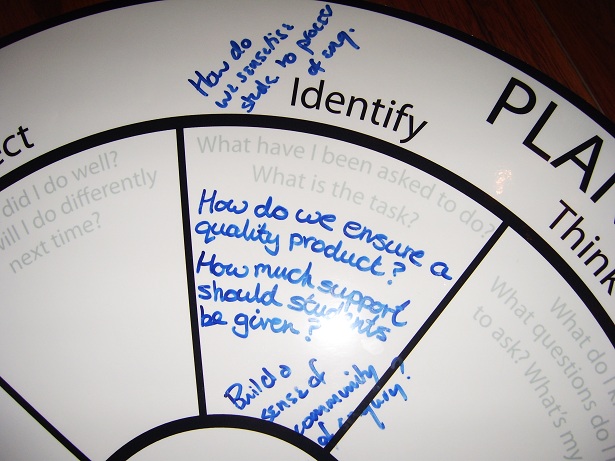
This is fast becoming something of a mantra for project based learning pedagogy at our school:
Do The Project First!
You may have read in earlier posts that in my school I am responsible for Create, which is a trans-disciplinary course in KS3 combining music, media and drama. It has long been the shared view in our team that the ultimate synergy of the three disciplines is film and we have now had two bites at the cherry with some success but many failings.
There are logistical issues which are a thorn in our side, mainly resultant from the capacity and scale for which we are required to plan and execute. At any one moment there are 180 students in Create shared between specialist teachers for each of the disciplines.
Two years ago, each half of year 8 (180 students) teamed up to become a film production company and we made our own version of Twilight. The process was fantastic, students were booking into our green screen studio to record scenes that they had rehearsed, to be met by their peers who had set up the studio for green screen video recording. The scenes were filmed and shared with a group of editors in the classroom who worked with the raw footage, taking out the green background using chromakey and editing in multi layered backgrounds which they had prepared in photoshop. At the same time composers were working with the themes from the twilight soundtrack to create music suitable to underscore the scenes.
There was a real buzz about the department and then when we came to show the complete film back in the hub (our performance space) it fell a little flat. Even our students are still focussed on content and despite the amazing journey they had gone on, they could not get past the fact that the final film did not look great. Our knowledge of chromakey was in its infancy, so many of the backgrounds looked too artificial, camera wobbles meant that actors bobbed up and down against their background and due to time constraints and the aforementioned capacity issues we did not have time to redraft scenes. We had 6 actors in the role of Edward Cullen and Bella, which resulted in serious continuity issues. All of which combined to leave us feeling a little underwhelmed and determined to get it right the next year.

So last year we changed tack and in an effort to negate the final product having a polished look, we used 'Be Kind Rewind' as our stimulus. If you haven't seen the movie, the basic premise is that Jack Black accidentally wipes all of the VHS tapes in his friend's store and they remake the film on a shoestring budget, this is called sweding movies (taken from custom Swedish furniture). Our students seemed switched on by the stimulus and we had them working in groups rather than as a whole year group. We were much tighter in the pre-production stage with check-lists for each stage of their planing, each tick resulting in their wacky racer moving a little further along the road at the front of the class.

This engaged the students for a while but it became death by planning sheets and time that would have been more useful spent filming, making mistakes and correcting them, was spent doodling costume designs instead. What we thought might turn out as well considered melodrama, actually led to the drama aspects of the project becoming somewhat of a joke, and acting skills were not really being enhanced to any measurable degree. Another factor that was not ideal was that we asked the groups to rotate around the roles of actors, editors and composers and so less time was spent in each. So rather than deep learning in specialist areas we skimmed the surface of the content in many cases, more lessons learned! The final products were highly mixed and often funny, but lacking the kind of quality that we were striving for and so this year it has been back to the drawing board.
It is said that hell is paved with good intentions, and last year we intended to make a "sweded" movie as part of our CPD time to use as a model but many reasons, none of them really good enough, we did not get round to doing it.
This year we have committed (thanks team!) a significant amount of our CPD time to "Doing the project first", the mantra taken from an inspirational visit to High Tech High in San Diego.
The idea being that if you go through the steps that the students are going to go through you can see the choke points, work out logistically what are the problems and solutions, check that the intended learning is being delivered and at the end have an exemplar to use alongside real world models.
The running gag in our department is "Can we do the same next year?" as we are constantly looking at, revising and tweaking our enquiries and projects and this year it is no different. The film making project is in a new guise with a new driving question of "How do you tell a story using film?"
We have some excellent short scripts for stage adaptations of some Grimm Fairy tales written by Carol Ann Duffy and have chosen 'Hansel & Gretel' as a piece that more easily accessible and "Ashputtel" as a piece that presents a greater challenge. Students will be challenged to take the stage script and adapt it for the medium of film, thinking about what changes that will necessitate and how the audiences are different for each. This time students will specialise in media as script writers, storyboarders, directors and film editors. In drama they will become actors (and dancers if they choose to), and the musicians will be film composers underscoring the film. This specialism should hopefully deal with the issues of capacity and time to redraft, rather than last year's carousel.
The completed films will be shown at a community event in the Hub at Easter (with popcorn of course!). I would love to have our excellent local film house the Tyneside Cinema involved and we do have contacts, but at the moment I am hedging my bets and waiting to see what our "DTPF!" model turns out like. As I write this I think that maybe I am being a coward here, and if they were on board from the start that would add a layer of authenticity to the project. Hmmm, more thought needed here! Anyway DTPF!
We met as a team for the first time today to begin the project ourselves. We read the script for 'Hansel & Gretel' and decided to try and make our film as true to the atmosphere of the script as possible, the genre being a fantastical thriller, set in an alternate fairy tale 19th century. We are taking inspiration from the recent Grimm brothers movie (particularly musically), and Red Riding Hood visually.
We have the facility and increasing know how to use Adobe CS to edit the film, create backgrounds for green screen scenes and add after effects, and intend to use these facilities to transform environments in and around our school into those of the world in which the piece is set.
I have to say that I am extremely excited by the prospect of collaborating in such an authentic and creative way and I know that this is shared by the team. This afternoon as we began to read through the script my colleague Rob stated quite beautifully that "I know we have to be here anyway, but I couldn't imagine anything else I would rather be doing than this", and our student teacher Natalie beamed at the idea of storyboarding ideas with the comment "This is great, it's just like being back at university".
Having discussed the big picture for our movie we split into our specialist groups and began to think about our roles for pre-production, developing the storyboard and script, beginning characterisation and composing the leitmotif themes that would be the building blocks for the score. Here are some of my compositional sketches in their infancy from this afternoon.
It is true, and in this we are very lucky, that we are given directed time for CPD on Wednesday afternoons, but this to me is CPD as it should be. There is a palpable enthusiasm centred around a shared goal which we hope will reap dividends in the execution of the project. I feel that for the first time in a while I am really putting my skills as a musician as well as a teacher to use, and bringing a little bit more passion to what I do.
We intend to capture our journey in making our model film with videos, blogs and reflection, and hopefully some of that enthusiasm will translate from our final product to our students as they begin creating their films after Christmas (it is all about them after all!)
Do The Project First!
You may have read in earlier posts that in my school I am responsible for Create, which is a trans-disciplinary course in KS3 combining music, media and drama. It has long been the shared view in our team that the ultimate synergy of the three disciplines is film and we have now had two bites at the cherry with some success but many failings.
There are logistical issues which are a thorn in our side, mainly resultant from the capacity and scale for which we are required to plan and execute. At any one moment there are 180 students in Create shared between specialist teachers for each of the disciplines.
Two years ago, each half of year 8 (180 students) teamed up to become a film production company and we made our own version of Twilight. The process was fantastic, students were booking into our green screen studio to record scenes that they had rehearsed, to be met by their peers who had set up the studio for green screen video recording. The scenes were filmed and shared with a group of editors in the classroom who worked with the raw footage, taking out the green background using chromakey and editing in multi layered backgrounds which they had prepared in photoshop. At the same time composers were working with the themes from the twilight soundtrack to create music suitable to underscore the scenes.
There was a real buzz about the department and then when we came to show the complete film back in the hub (our performance space) it fell a little flat. Even our students are still focussed on content and despite the amazing journey they had gone on, they could not get past the fact that the final film did not look great. Our knowledge of chromakey was in its infancy, so many of the backgrounds looked too artificial, camera wobbles meant that actors bobbed up and down against their background and due to time constraints and the aforementioned capacity issues we did not have time to redraft scenes. We had 6 actors in the role of Edward Cullen and Bella, which resulted in serious continuity issues. All of which combined to leave us feeling a little underwhelmed and determined to get it right the next year.

So last year we changed tack and in an effort to negate the final product having a polished look, we used 'Be Kind Rewind' as our stimulus. If you haven't seen the movie, the basic premise is that Jack Black accidentally wipes all of the VHS tapes in his friend's store and they remake the film on a shoestring budget, this is called sweding movies (taken from custom Swedish furniture). Our students seemed switched on by the stimulus and we had them working in groups rather than as a whole year group. We were much tighter in the pre-production stage with check-lists for each stage of their planing, each tick resulting in their wacky racer moving a little further along the road at the front of the class.

This engaged the students for a while but it became death by planning sheets and time that would have been more useful spent filming, making mistakes and correcting them, was spent doodling costume designs instead. What we thought might turn out as well considered melodrama, actually led to the drama aspects of the project becoming somewhat of a joke, and acting skills were not really being enhanced to any measurable degree. Another factor that was not ideal was that we asked the groups to rotate around the roles of actors, editors and composers and so less time was spent in each. So rather than deep learning in specialist areas we skimmed the surface of the content in many cases, more lessons learned! The final products were highly mixed and often funny, but lacking the kind of quality that we were striving for and so this year it has been back to the drawing board.
It is said that hell is paved with good intentions, and last year we intended to make a "sweded" movie as part of our CPD time to use as a model but many reasons, none of them really good enough, we did not get round to doing it.
This year we have committed (thanks team!) a significant amount of our CPD time to "Doing the project first", the mantra taken from an inspirational visit to High Tech High in San Diego.
The idea being that if you go through the steps that the students are going to go through you can see the choke points, work out logistically what are the problems and solutions, check that the intended learning is being delivered and at the end have an exemplar to use alongside real world models.
The running gag in our department is "Can we do the same next year?" as we are constantly looking at, revising and tweaking our enquiries and projects and this year it is no different. The film making project is in a new guise with a new driving question of "How do you tell a story using film?"
We have some excellent short scripts for stage adaptations of some Grimm Fairy tales written by Carol Ann Duffy and have chosen 'Hansel & Gretel' as a piece that more easily accessible and "Ashputtel" as a piece that presents a greater challenge. Students will be challenged to take the stage script and adapt it for the medium of film, thinking about what changes that will necessitate and how the audiences are different for each. This time students will specialise in media as script writers, storyboarders, directors and film editors. In drama they will become actors (and dancers if they choose to), and the musicians will be film composers underscoring the film. This specialism should hopefully deal with the issues of capacity and time to redraft, rather than last year's carousel.
The completed films will be shown at a community event in the Hub at Easter (with popcorn of course!). I would love to have our excellent local film house the Tyneside Cinema involved and we do have contacts, but at the moment I am hedging my bets and waiting to see what our "DTPF!" model turns out like. As I write this I think that maybe I am being a coward here, and if they were on board from the start that would add a layer of authenticity to the project. Hmmm, more thought needed here! Anyway DTPF!
We met as a team for the first time today to begin the project ourselves. We read the script for 'Hansel & Gretel' and decided to try and make our film as true to the atmosphere of the script as possible, the genre being a fantastical thriller, set in an alternate fairy tale 19th century. We are taking inspiration from the recent Grimm brothers movie (particularly musically), and Red Riding Hood visually.
We have the facility and increasing know how to use Adobe CS to edit the film, create backgrounds for green screen scenes and add after effects, and intend to use these facilities to transform environments in and around our school into those of the world in which the piece is set.
I have to say that I am extremely excited by the prospect of collaborating in such an authentic and creative way and I know that this is shared by the team. This afternoon as we began to read through the script my colleague Rob stated quite beautifully that "I know we have to be here anyway, but I couldn't imagine anything else I would rather be doing than this", and our student teacher Natalie beamed at the idea of storyboarding ideas with the comment "This is great, it's just like being back at university".
 |
| "I couldn't imagine anything else I'd rather be doing" |
Having discussed the big picture for our movie we split into our specialist groups and began to think about our roles for pre-production, developing the storyboard and script, beginning characterisation and composing the leitmotif themes that would be the building blocks for the score. Here are some of my compositional sketches in their infancy from this afternoon.
It is true, and in this we are very lucky, that we are given directed time for CPD on Wednesday afternoons, but this to me is CPD as it should be. There is a palpable enthusiasm centred around a shared goal which we hope will reap dividends in the execution of the project. I feel that for the first time in a while I am really putting my skills as a musician as well as a teacher to use, and bringing a little bit more passion to what I do.
We intend to capture our journey in making our model film with videos, blogs and reflection, and hopefully some of that enthusiasm will translate from our final product to our students as they begin creating their films after Christmas (it is all about them after all!)