Latest Article Get our latest posts by subscribing this site

The “Dégringolade” of It All

Dégringolade is a French word meaning to tumble down, to decline. Jacques Barzun wrote a very large book titled From Dawn to Decadence: 500 Years of Western Cultural Life in which he traces the fortunes of Western civilization from 1500 until now and sees that great tradition as coming to an end. Far be it from me to disagree with Jacques Barzun, one of the most educated and sage scholars of the century. We may indeed be coming to the end of at least one great phase of the Western tradition. But as this has happened a few times before, perhaps it is not so much an end as a turning point.

There are two fundamental historic attitudes toward the arts: the urge to revive the 'classical' however one may envision it, and the contrary urge to strike out in new directions. These two urges seem to be present in all times and eras. Here, for example, is a quote that demonstrates the former urge:

“I, too, used to like modern buildings, but when I began to appreciate classical ones, I came to be disgusted with the former.” The Italian architect and sculptor Antonio Filarete, writing in the 1460s and referring to Gothic buildings.

And here is a quote that shows the latter urge:

In 1558 the Italian music theorist Gioseffo Zarlino published his Le istitutioni harmoniche in which he commented "At present it is hardly possible to find an instance of fugal writing that has not been used a thousand million times by other composers."

At any given moment one can bemoan that we are stuck in a rut and just regurgitating what has been done before and simply must find new approaches. Or one can bemoan that we are sinking into decadence and barbarism and must rediscover the classical ideals and values. The Renaissance, ironically enough, in an attempt to revive classical ideals, instead managed to start Western culture in entirely new directions. Attempting to revive the Greek practice of musical accompaniment to tragedies, they invented opera.

I think we are at a potentially very interesting and possibly fruitful moment in the history of Western music. After a century of constant innovation and breaking with tradition, I think now is the time to consolidate. This is not at all the same as being reactionary. One can never return to a previous era and every time you attempt to revive something, you probably end up inventing something new, just as many attempts to invent something new end up as tiresome repetitions of something that came before.

But what an incredible storehouse of styles, idioms and techniques the 20th century has left us! There is so much there that can be explored and rediscovered. As a very modest example, when I set out to write a song on a poem by the 8th century Chinese poet Li Po, one line in the poem made me choose a technique often used by John Cage: the preparation of one string of the guitar so as to make a bell-like sound. The result is a piece with an unusual flavor:


Another example might be this piece by Osvaldo Golijov, titled Tenebrae which is a reinterpretation of music by François Couperin:


There are so many possibilities. I feel that what is important is reviving aesthetics rather than technique as a guide. So much of the last century was a frantic search for the new, regardless of whether it was good or bad, that now it is time to sort it all out--in individual ways, of course. Time to re-examine styles and ideas of the past, seek out interesting juxtapositions and relearn the aesthetics of music.

Here is another example: a piece for violin and piano titled Aria by Kevin Puts that combines a violin line that tends to the romantic with a minimal piano accompaniment. The result is neither romantic nor modern but something else. It is that aesthetic "something else" that is interesting, I think.


Bach vs Beethoven

Most lists of the greatest composers start with two names: Johann Sebastian Bach (1685 - 1750) and Ludwig van Beethoven (1770 - 1827). Usually Bach is first and Beethoven is second as in the list that the music critic for the New York Times came up with a few years ago.

J. S. Bach

Ludwig van Beethoven

I've been writing a lot of program notes lately and every time I have to write notes on Bach or Beethoven I try to write something different. It keeps bringing me back to who these two composers are, what makes them stand out. They are very different figures. Bach is the master craftsman. To this very day, music students study how Bach handled harmony. A decade or so after he died, in 1764, people (among them the scholar F. W. Marpurg and Bach's son C. P. E. Bach) started putting together a collection of Bach's chorale harmonizations. The collection, revised many times over the years, finally comprised 371 chorale harmonizations and 69 chorale melodies with figured bass. The melodies were not original with Bach, but traditional Lutheran hymns; Bach just contributed the harmonies. This collection has remained in print ever since and I have a copy on my desk as I write this. I suspect it is the longest-running music publication ever, now almost in its 250th year. It is still in print because Bach is universally recognized as the great master of harmony.

Beethoven is rather a different figure. Rather than summing up, perfecting, gathering together all the musical traditions of his day, as Bach did, Beethoven challenged every tradition, delved into the depths of the structure of music and reconstructed it from the ground up. Bach was the master craftsman, Beethoven the perpetual revolutionary. Bach built towering edifices of music, brick by brick. Beethoven created dynamic structures where every element is being constantly dissolved and re-created. Let's find some examples before my prose spins off into the mystic!

Here is the chorale "Jesu, joy of man's desiring" from Cantata 147 by Bach. It is one of his most famous pieces, a setting for choir and orchestra of a traditional hymn.


Beethoven creates an entirely different kind of musical world. Here is one of his most famous pieces, the first movement of his piano sonata op 27 no. 2, nicknamed the "Moonlight":


The feeling of solidity, of mastery, is also evident in more expansive pieces by Bach, such as his Magnificat. Here is the opening section:


While the dynamic energy of Beethoven, that always seems about to tear the music apart, is also evident in larger pieces. Here is the first movement of his 5th Symphony as an example:


Ever since Beethoven's example, the "composer as revolutionary" model has tended to prevail. Most 20th century composers saw themselves as revolutionaries, not master craftsman. This may be about to change as perpetual revolution tends to lead to chaos and fewer ticket sales! My personal feeling is that I am inclined, as a composer, to look back at all the crazy things that were done in the last hundred years and see what interesting things can be adopted or salvaged. For example, in my setting of a poem by Li Po for voice and guitar, I took my cue from a mention of "bells of frost" in the poem to use an idea from John Cage. I have the guitarist put a paper clip on the sixth string of the guitar which creates a very unusual and unexpected sound, much like a bell. This single element gives the song another dimension. Here is the result:


Artistry and Economics

Every now and then you read a piece of news that reveals a new social fault line: like this one. Here is part of a press release:
On January 31, Allianz and Lang Lang have started a global partnership: Lang Lang will become a global Allianz brand ambassador. At the same time, Allianz and the Lang Lang International Music Foundation announced that the Foundation plans to run a dedicated youth programme to be sponsored by Allianz.
According to Wikipedia, Allianz:
is a German multinational financial services company headquartered in MunichGermany. Its core business and focus is insurance. As of 2010, it was the world's 12th-largest financial services group and 23rd-largest company according to a composite measure by Forbes magazine.
Also according to Wikipedia, Lang Lang is:
 a New York-based Chinese concert pianist who has performed with leading orchestras in Europe, the United States and his native China. He is known for his concert performances, television, as well as releasing albums and soundtracks. Lang has done much to encourage children and young musicians to take an interest in classical music, especially through the international foundation he launched in New York in 2008.
High-profile athletes have long exploited their celebrity to win promotional contracts with large companies who see a big publicity benefit to throwing a bit of money at a famous person who will say nice things about them. It has alway seemed a bit odd to me, especially when it blows up as it recently did with Lance Armstrong and Tiger Woods. Would you actually buy a product because an athlete endorses it? Really?

Musicians have been exploring some interesting ways of increasing their income. Dr. Dre is currently in the lead as I talk about in this post about the highest-paid musicians of 2012.

So what's the social fault line? Maybe it is more of a philosophical fault line. Here is the problem: it seems to me that more and more public life, that is to say the shared public arena or agora, is dominated by fantasy. Beyoncé's Superbowl half-time show, pop music generally, is all about various forms of fantasy. But it extends a lot further than that. The looking to celebrities, especially those known mainly for being famous, for endorsements, opinions, wise counsel, is a widespread and inherently idiotic practice.

Let's take a closer run at that Allianz press release for some examples of fantasy speak:
With its support of the exclusive youth programme, Allianz will promote the Foundation’s aim to inspire the next generation of classical musicians and to encourage music performance as a means of social development.
 
The programme will give young pianists from around the world the opportunity to work with Lang Lang. The aim is to share Lang Lang’s passion for music and make the young musicians ambassadors among their peers through a life-changing experience. “Music makes life better. It heals, unites and inspires - and it makes us better people,” is the artist’s conviction.
Lots of happythoughts, sure, but what does all this actually mean? The word "exclusive" has the sheen of, well, exclusivity, but no actual content. There are lots of youth programs. What about "inspire"? That's a nice word, but I can't actually think of a single instance in the whole history of music where a foundation has inspired anything other than the frantic filling-out of grant application forms. Inspiration comes from lots of unlikely places--just not foundations. Does Lang Lang have a "passion" for music? Perhaps--he certainly has a driving ambition. In what sense could "young musicians" be "ambassadors among their peers"? Let alone through a "life-changing experience". See, these are just buzz phrases that have no reference whatsoever to anything in the real world.

What bothers me is that we live in the real world, but all our public discussion seems to live in some weird fantasy world. I think music is another kind of 'real' world, with its own set of joys and sorrows, triumphs and frustrations, beauties and uglinesses. I dislike happythought talk about music just as much as I do happythought talk about the real world. I dislike the idea of successful classical musicians like Lang Lang being pulled into the kind of big dollar promotional crap that dominates the world of sports.

I'm just a grouch! Now let's listen to some Lang Lang:


Trying to play the "Flight of the Bumblebee" on an iPad. Sigh. Now of course Lang Lang is a fine pianist and musician. I just put that up to show the kinds of things artists do these days to show what regular folk they are. Here is Lang Lang in a serious recital in Vienna:


Schoenberg, Berg, Webern

I left things hanging a bit with my last post on Schoenberg. Let me see if I can wrap things up, provisionally at least. My exploration of classical music in the early days was partly guided by reading some library books and the purchase of recordings. One led to the other, of course. For some reason, the tiny municipal library I had access to had several books on 20th century music. In retrospect the interesting thing about these books was their relatively uniform view on the ideology of 20th century music. From these books I took for granted both who were the important figures (Schoenberg, Webern, Berg) and the context for understanding why: technical progress in new ways of writing music.

I accepted this paradigm for a long time and only much later did I really started to doubt it. I think the first inkling of a problem came in undergraduate music when I was in the listening library one day sampling some new music recordings. I happened to put on a disc of some Stockhausen for multiple orchestras (Carré or something) and followed it with Drumming by Steve Reich. The Reich was much more interesting and made a larger impact for me because it was not maximalizing dissonance and complexity! Well, according to the aesthetic parameters that I had learned regarding 20th century music, that was just wrong!

Technical progress in writing music is a very problematical concept as soon as you start to unpack it. For one thing it tends to place music in the same realm as science: research and development of new musical ideas. Milton Babbitt is the locus classicus for this viewpoint; another prominent practitioner is Pierre Boulez. Let's listen to some Babbitt. Here is his Composition for Four Instruments from 1948:


How are you supposed to listen to that? Are you supposed to hear the structure? Do you have to listen with the score? Should you study the score first? What kind of aesthetic experience could you have? Also, I have to point out that, there are a distressingly large number of pieces in this genre that all sound the same to me: the disjointed, fragmentary rhythms, the wide leaps in the melody, the huge changes in dynamics, the chopped off phrases--it all adds up to the same aesthetic effect. For me.

This is music that seems to be focussed only on the process of creating it. The syntax of it. The aesthetic effect is somewhat secondary. But it wasn't always so. If we go back to Schoenberg, Berg and Webern, two of the three always seemed to have also have a semantic or content side as well. In his early works such as Verklärte Nacht or Pierrot Lunaire or even the Six Little Piano Pieces, op 19, Schoenberg has a great deal of 'content'. Later on, he seems to have less and less, though there are exceptions such as his unfinished opera Moses und Aron. Some of his content seems to be related to issues surrounding his Jewish identity and the rise of anti-semitism in Nazi Germany. In other words, extra-musical events.

Schoenberg's student Alban Berg seems to have even more leaned towards the 'content' aspect and away from the structural aspect. His Lyric Suite for string quartet, long thought to be simply abstract music, turned out to have a rather detailed secret program referring to an affair between Berg and Hanna Fuchs-Robettin. Here is the first movement to give you a sense of the music:


While written using 12-tone procedures, that music certainly has an expressive 'content' in the sense I am using the word. Berg, as the author of two successful operas, Wozzeck and Lulu, has a strong sense of theater in his music. This has not ever been discussed to my knowledge, but his Violin Concerto contains instructions to the orchestra to perform certain actions onstage--again, the result is a kind of theatre. Mind you, I have not noticed any orchestras actually enacting these instructions! But they are there.

Anton Webern went in quite the opposite direction: he has the least 'content' of the three and his music seems to be the most concerned solely with the technical aspects of composition. It is hard to imagine a 'secret program' in any of Webern's pieces! Here is his String Quartet, Op 28:


I think you can hear how that is going to lead directly to Babbitt and Boulez. After the war the choice was made in places where composition was being taught, like Darmstadt, to follow the example of Webern and not the example of Berg. We might speculate that with the just past horrors of the war, the last thing anyone wanted was aesthetic content! On the other hand, this didn't seem to stop people like Shostakovich from writing content-full music after the war. But in Western Europe and North America, the ideology of music composition was to take Webern as a model and stress the syntax of music while ignoring the semantic. Even though this model has begun to break down there are still places that turn out composition students who seem to follow it.

If I might inflict on you a metaphorical way to distinguish Schoenberg from his students I could compare Schoenberg himself to a hearty dish like wienerschnitzel which would make Alban Berg a Sachertorte and Anton Webern, well, schnapps!

The Musical Sublime

I was just reading this post over at Norman Lebrecht's site. In it he is talking about words that should be banned from music reviews due to overuse or hackneyed cliché. The very first word he chose, "sublime" caught me up because, while I realize that it is frequently misused, it is a venerable and important word in the history of aesthetics. The source is a book by Edmund Burke called A Philosophical Enquiry into the Origin of Our Ideas of the Sublime and Beautiful (1756, revised 1757). In it he describes the sublime as follows:
Whatever is fitted in any sort to excite the ideas of pain and danger, that is to say, whatever is in any sort terrible, or is conversant about terrible objects, or operates in a manner analogous to terror, is a source of the sublime; that is, it is productive of the strongest emotion which the mind is capable of feeling. I say the strongest emotion, because I am satisfied the ideas of pain are much more powerful than those which enter on the part of pleasure.
This is an extremely important concept in aesthetics. I don't think we could really talk about how a lot of music affects the listener without this concept. Burke goes on as follows:
The passion caused by the great and sublime in nature, when those causes operate most powerfully, is astonishment: and astonishment is that state of the soul in which all its motions are suspended, with some degree of horror.
He talks about beauty in this way:
I call beauty a social quality; for where women and men, and not only they, but when other animals give us a sense of joy and pleasure in beholding them (and there are many that do so), they inspire us with sentiments of tenderness and affection towards their persons; we like to have them near us, and we enter willingly into a kind of relation with them, unless we should have strong reasons to the contrary.
And about the relation between beauty and the sublime:
It is my design to consider beauty as distinguished from the sublime... By beauty, I mean that quality, or those qualities in bodies, by which they cause love, or some passion similar to it... attending to their quantity, beautiful objects are comparatively small... the beautiful in music will not hear that loudness and strength of sounds, which may be used to raise other passions; nor notes which are shrill, or harsh, or deep; it agrees best with such as are clear, even, smooth, and weak. The second is; that great variety, and quick transitions from one measure or tone to another, are contrary to the genius of the beautiful in music. Such transitions often excite mirth, or other sudden or tumultuous passions; but not that sinking, that melting, that languor, which is the characteristical effect of the beautiful as it regards every sense.
He contrasts them as follows:
On closing this general view of beauty, it naturally occurs that we should compare it with the sublime; and in this comparison there appears a remarkable contrast. For sublime objects are vast in their dimensions, beautiful ones comparatively small; beauty should be smooth and polished; the great, rugged and negligent: beauty should shun the right line, yet deviate from it insensibly; the great in many cases loves the right line; and when it deviates, it often makes a strong deviation: beauty should not be obscure; the great ought to be dark and gloomy: beauty should be light and delicate; the great ought to be solid, and even massive. They are indeed ideas of a very different nature, one being founded on pain, the other on pleasure; and, however they may vary afterwards from the direct nature of their causes, yet these causes keep up an eternal distinction between them, a distinction never to be forgotten by any whose business it is to affect the passions.
We notice when listening to music that there are soft, delicate passages and also wild, fiery passages. The former given perhaps to the flutes and oboes and the latter to the trombones and tympani with the strings always present as a kind of substrate. This corresponds to Burke's classification of the beautiful and the sublime. If you are using an aesthetics that talks about beauty, then you also need the concept of the sublime, otherwise you can only talk about those soft flute passages and how beautiful they are and are at a loss for words to explain why that noisy and terrifying passage with the trombones and tympani is even in the piece.

I can describe the beautiful and sublime in terms of personal experience. I was once out hiking in the mountains on Vancouver Island and passed through some alpine meadows of wildflowers. Very beautiful! Then I climbed up a ridge that I thought was the peak. When I got to the top, as my head rose to the point where I could see past the ridge, suddenly I realized that I was on a mere foothill. Towering above me was a vast, massive crag that was the true peak: miles away and thousands and thousands of feet higher. That was the sublime: something great and astonishing and a bit fearful.

Here is the whole of Burke's book if you want to have a look.

The symphonies of Sibelius are not a bad place to look for an example of the sublime and beautiful in music:


The Structure of Musical Revolutions

The title immediately recalls the book by Thomas Kuhn, The Structure of Scientific Revolutions. Wikipedia summarizes the basic idea as follows:
Kuhn made several notable claims concerning the progress of scientific knowledge: that scientific fields undergo periodic "paradigm shifts" rather than solely progressing in a linear and continuous way; that these paradigm shifts open up new approaches to understanding that scientists would never have considered valid before; and that the notion of scientific truth, at any given moment, cannot be established solely by objective criteria but is defined by a consensus of a scientific community. Competing paradigms are frequently incommensurable; that is, they are competing accounts of reality which cannot be coherently reconciled. Thus, our comprehension of science can never rely on full "objectivity"; we must account for subjective perspectives as well.
A friend of mine gave me a copy of the book way back in the 70s or 80s and I found it fascinating. But as time goes on I am less and less convinced of its application to science, but more and more see its potential application to aesthetics. Science is about objective reality and a paradigm shift is really nothing but seeing all the data from an entirely new angle. The only thing that might be subjective there is the angle. But aesthetics? That's a whole 'nother thing.

I think that what we see in the dislocations of music history might well be described as a "paradigm shift". For example, a famous one is the shift from the 16th century way of structuring music based on equal, independent voices in a context of smoothly flowing, consonant counterpoint to the 17th century way based on the polarity of soprano and bass lines with other voices used to fill out the harmony and the de-emphasis on counterpoint and the increased importance of dissonance. Or the shift from the 19th century romantic ideals of naturalism, richly textured harmony and orchestration to the early 20th century practices of rhythmic intensity, atonality and artificiality.

Examples? Sure, we got examples! Here is the 16th century texture with a madrigal by Morley:


And this is the 17th century texture with a piece by Caccini, one of the inventors of 17th century style:


Here is the 19th century with an overture by Brahms:


And the 20th century with a string quartet movement by Bartok:


Plainly these pieces are structured in very different ways with very different aesthetic goals and need to be listened to in different ways. In Kuhn's terms these competing paradigms are incommensurable. But in aesthetics, my brand of aesthetics at least, judgments and evaluations are always necessary if only because we have to choose what to listen to out of an immensity of music. I think it is possible to evaluate pieces within their paradigm: there are better and worse examples of 19th century music, for example. But is it possible to evaluate different paradigms? That is something that is much harder to argue for. How do you evaluate paradigms? Not by different paradigms, surely. Are there aesthetic standards that transcend any particular paradigm? I think there must be, because we can come up with great works of music from all sorts of different times and places. Deciding what makes these works 'great' might be pretty tough though, as their qualities are, yes, incommensurable.

Just another one of those mysteries of music I will say...

Switching on Bach


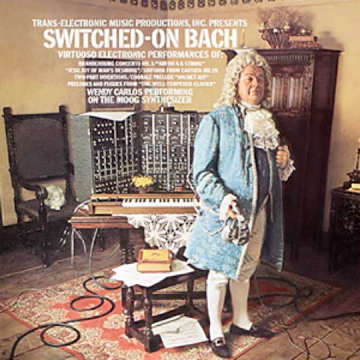
Time for a confession: the first Bach recording I ever purchased was Walter/Wendy Carlos' Switched-On Bach a synthesizer version of some popular Bach pieces released in 1968. I think I bought it in 1970. I was at the time an electric bass and six-string guitarist, recent member of several different bands and new admirer of classical music. Here is an example of the kind of arrangement found on that album:


I am reminded of this by an article in The Nation about a new book by Paul Elie. Reviewer Michael O'Donnell describes it as follows:
Classical music has experienced years of diminishing ticket sales and the indifference of young listeners and so must exploit technology, Elie believes, in order to endure. To prove as much, he lived for “a thousand and one nights” with Bach’s music on compact disc, MP3 and radio, and he emerged on the other side of the experience eager to proselytize both the music and the recording technology that captured it. Against the instinct of purists to denounce the ubiquitous cheapening of classical music in ringtones, overheated movie trailers and hip-hop songs, Elie contends:  “The more various our encounters with Bach, the more objective his genius is.”
 At the end O'Donnell comments that Elie should spend less time with recordings and more time listening to Bach live. Well, sure, but I think it would be even better to take a few lessons and learn how to play a little Bach. You don't need to be a virtuoso to experience playing Bach and it will connect you with the music in a way that no amount of listening to recordings or going to concerts will do.

But what I really want to talk about is how these kinds of disputes between people who argue for popularizing Bach by playing him on synthesizers or jazzing him up or playing him in subway stations as they recently did in New York and people who argue for more historically-informed performances of Bach are actually a kind of category mistake.

The notion of a category error comes from a 1949 philosophical inquiry by Gilbert Ryle in a book titled The Concept of Mind and it is a useful notion. To give a musical example, you might be giving an introduction to classical music to a friend by taking him to an orchestral concert. You point out the different instruments to him: those are the violins and over there are the flutes. He says, "ok, I see the violins and the flutes and the other instruments you pointed out, but I don't see the orchestra. Where is the orchestra?" He has made the category mistake of not understanding that all the instruments together constitute the orchestra.

I think that nearly all the typical disputes about Bach, or classical music generally, are plagued with category mistakes. When we talk about performing Bach on synthesizers or on harpsichord, in a concert hall or a subway platform, on a recording with digital editing or in your music room at home we are talking about the accidentals of music, not the essence of music.

I notice that much discussion of aesthetics avoids the words 'good' and 'bad' as if they were infectious. The paragraph I quote above twists around, but ends up saying that Bach's genius is "objective", which I take it means 'good'. When you play Bach you can handle a phrase well or badly. Your texture can be clear or muddy. There are a thousand things you can do that work or don't work--and by 'work' I mean are musically effective. It is this sort of thing that matters. If I want to demonstrate how a phrase should (or could) be shaped effectively, I could do so on a guitar, a piano, a synthesizer or a copy of an historical harpsichord and which I chose would be nearly irrelevant. I say 'nearly' because some qualities, like speed of decay or type of attack, could influence how I shaped the phrase.

You can deliver an effective performance of Bach in many different ways on many different instruments which is why transcriptions of Bach are so frequent and so successful. You can also deliver many different kinds of ineffective, maudlin, muddy and wobbly performances of Bach on many different instruments. This is the kind of distinction that matters: between good and bad, not between this model synthesizer and that kind of violin bow, between a performance on piano or one on harpsichord.

We admire the performances of Glenn Gould not because he had an eccentric personality or sat on a funny chair or hummed when he played or isolated himself in the studio or chose a certain editing procedure, but because he played Bach well. Really well. That's the only thing that matters.


Bach endures not because of the use or non-use of any particular technology or even musical instrument, but because his music is aesthetically powerful. This is what drives everyone from Carlos to Gould to me to play Bach and a host of others to listen to Bach.

John Cage at 100

I have posted on John Cage before, but I just read an interesting essay on him by Daniel Asia. I also read a rebuttal to the essay in NewMusicBox and a whole series of comments on it. The first thing I notice is that while Daniel Asia gives a fairly detailed, though not technical, series of reasons why he thinks Cage is not an important composer, Dan Joseph in NewMusicBox, does not give what I consider musical reasons why Cage is important, restricting himself to remarks about the diversity of modernism and if you disagree you are "mean-spirited". And I really don't care too much about Cage's contribution to an American musical identity. I'm not an American. As a Canadian who lives in Mexico, I'm not a nationalist of any kind for that matter. So let me weigh in on John Cage.

Let's start with the first part of the Sonatas and Interludes for prepared piano, a piece a lot of commentors have said is their favorite Cage:


It's not Mozart! Sorry, couldn't resist. The thing is that I am not unsympathetic to Cage's aesthetic. There was a time, perhaps twenty years ago, when I was very much a Cage admirer. Though even then I found his writings ON music to be more interesting than his writing OF music. I contemplated giving a performance of some of his talks on music. I even wrote at least one piece very strongly influenced by his aesthetic. But as time went on, I'm afraid I have become an apostate of Cage's aesthetic as I don't believe it is a musical aesthetic at all. I can't quite agree with Daniel Asia when he says that "Sonatas and Interludes offers many movements that add up to no perceivable aural structure." The different movements each have a character that is largely rhythmic. Sonata IV, for example, is full of "fiveness" if I can call it that: a lot of quintuplets and time signatures involving 5.

Imagine you want a career as a modernist composer, but you have no real sense of harmony or melody. Your gifts, such as they are, lie in the area of rhythm. Writing for prepared piano, where screws and bolts alter the pitch to the point that it is really not possible to analyze the harmonic structure, is your way to avoid being evaluated in areas you are weak. It's brilliant, really! But it is a kind of aesthetic fraud. Is this what Cage did? I have no idea, I just present the possibility. Here is the second part of the Sonatas and Interludes:


When I was in my Cage phase, I can't say that I was thinking musical thoughts as such. Perhaps 'sound' thoughts or 'sonic' thoughts, but not musical thoughts as such. Cage presents, and intends to present, a huge challenge to aesthetics. But I think that the answer to the challenge is found by listening to his music. It is a simulacrum of music, to steal an idea from Baudrillard, a shadowy copy of music. One of the sonatas sounds like a horribly crippled prelude by Debussy, for example. You can listen to this music and enjoy it and have some kind of experience, but I have to agree with Daniel Asia, it is ultimately frustrating for the reasons he gives: "The emotional landscape is limited and proscribed, ultimately wan and shadowy."

The reasons for this are obvious: Cage was not writing music as such, he was creating a facsimile of music without harmony or melody, without anything but chance sounds within a rhythmic framework. Of course there is no narrative! For one of his talks, he wrote a talk, then cut it up and mixed the pieces randomly. There is not supposed to be a narrative in Cage. But writing music the way he did is to create, at best--at best--a private language, one that we are not privy to. For that reason, it fails as music. Here is part 3 of the Sonatas and Interludes:


But listen and make up your own mind, by all means. Just don't assume it is a musical success simply because everyone and his dog is putting on a John Cage concert for the centenary.

"Radical New Musical Languages"

Reading Alex Ross' blog this morning I notice that he is giving several talks inspired by his book The Rest is Noise.
On January 19th, The Rest Is Noise, a year-long festival inspired by the book of the same title, opens at Southbank Centre in London. I'll give four allied lectures over the course of the year; the first of these, "The Big Bang," is at noon on the 19th, in Queen Elizabeth Hall. It will survey the emergence of radical new musical languages in the late nineteenth and early twentieth centuries. Expect audio snippets of Debussy, Schoenberg, Stravinsky, Bartók, and many others, though Salome, featured that night at the London Philharmonic, will be the center of attention.
I think it may be time to have a closer look at the book, which seems to be having quite an influence on the way people look at music. But can you pick out the words in the above quote that caused my hackles to rise? Sure you can; I picked them for my title: "radical new musical languages." What's wrong with that?

Underneath the cool exterior and mellifluous writing style, Alex Ross is, I suspect, deeply conventional. He is not really a musicologist, but rather a journalist. But since musicologists these days are chasing one another down various rabbit holes, Alex Ross tends to fulfill the function of a public intellectual in music. Richard Taruskin is another, but as he sometimes expresses unusual, contrary opinions, he is less popular with the mass media. Alex Ross, however, seems more and more popular, so I think I will take a run through The Rest is Noise to see what assumptions he is operating under. In the meantime, though, let's just deconstruct that phrase "radical new musical languages."

That was most certainly not what was happening in the late nineteenth and early twentieth centuries. You may recall that on several occasions I have made the seemingly trivial point that music is NOT a language? Have a look here and here and here for some examples. Most of the time when people refer to music as a language they are simply making a metaphor and there is no real problem with it. But if someone is not aware that it is nothing but a metaphor, then some strange conclusions appear. You might start thinking that a composer can simply invent a new musical language. If music were a language, then that would simply not be possible for the very same reason that I cannot invent a new language. (Let me qualify that: of course, I can invent a new language. People have done so and Esperanto is an example. But these invented 'languages' are not languages in the sense that they are used by any community of humans. The most you could say is that someone invented the framework for a language--which was then ignored. Languages evolve naturally, they are not 'invented'.)

The philosopher Ludwig Wittgenstein came up with a very famous argument about why you can't invent your own private language, known as the private language argument. The concept of a language understood by only one person is incoherent: it violates the very notion of a language, a central concept of which is shared meaning. A language is a language if it has words and a dictionary you can look them up in. Now of course there are languages that are not even written, but they have the equivalent of dictionaries in tribal elders: "Grandma, what does "spadoinkle" mean?" If the idea of a private language is incoherent, then it would follow that all language is essentially public: that language is at its core a social phenomenon.

Music is also, at its core, a social phenomenon. Think about what that means for a moment. One consequence is that you cannot simply invent a new musical 'language'. While music is not a 'language', it has some language-like qualities. One of these is that it is a social phenomenon, perhaps a bit more so than the other arts. Take for example two fundamental kinds of music-making: singing and dancing. I talked about this here. Both song and dance are social. We sing words to other people to communicate with them. We prefer to dance with other people rather than alone for the same reason. Just what you communicate when you sing or dance with another might be hard to put into words, but the communication itself is undeniable.

So I think the consequence of all this is that a composer cannot simply invent a radical new musical language, though he can do something perhaps a bit less radical in re-shaping the way music is structured in some fundamental way. This is what those composers Alex Ross mentioned were doing. If you take a close look at Debussy you will see the music absolutely permeated on every level with the fundamental elements of tonal music. But you will also see how he has re-thought and re-shaped these elements.

Well, enough for today on this. Let's end with some Debussy so you can see what I mean.


Some Musical Jokes

There are different kinds of musical humor. Some you can hear over and over and enjoy them every time, like this Haydn minuet that has a very messed up meter:


But other kinds of musical humor, like some puns, are only funny once. If that. Norman Lebrecht has found one:


He loves it. I think it sounds like tango music as arranged by John Cage. Funny once. Another piece by Kagel is this one entitled "Ludwig van" in which brief chunks of Beethoven are sliced up and served with unpleasant clashes. Here is a mercifully brief extract:


There was a similar hit-and-run done on the prelude to the Third Violin Partita by Bach. It was released on the flip side of an LP of the Cage Concerto for Prepared Piano, but for the life of me I can't remember the composer! Gunther Schuller? Luciano Berio did another hit-and-run on the third movement of Mahler's Second Symphony in the third movement of his Sinfonia.


Believe it or not, this sort of thing used to be thought daring and progressive, the future of music. But, just like putting a pickled shark in a tank and calling it 'art', all this is pretty much a poor joke. Funny once.

UPDATE: Yes, I realize I sound a bit like an out-of-touch troglodyte in this post. Which makes Norman Lebrecht sound groovy and up-to-date? Can't leave it like that, so let me explain!

The problem with these kinds of things is that they are just too easy. Take some bits of Beethoven or Bach and chop them up. Mix indescriminately. Blend to serve. Ugh! This may have gotten everyone all a flutter in 1970 when it was new and unusual. But aesthetically, it is a nightmare. I wish I could find that Bach example, because it was a perfect illustration. Little bits of the violin partita prelude whistling past, combined with other bits in a horrible cacaphony. Easy to compose--awful to hear. When barbarians come to town, they tear down the bronze statues and melt them down. They collect the gold ornaments and melt them down. They rip the lead off the roofs of the churches and melt it down. How is what these 'composers' are doing any different?

Revolutionary, Reactionary, Or?

I may have mentioned at one point that some while back I became an apostate as regards avant-garde music. I simply decided to reject the basic assumptions of that aesthetic. I'm free to do that, as an artist, right? Just as for generations artists and musicians were free to accept the principles of the avant-garde. Oh, except that after a while, they were the only ones that were allowed, that were respectable, that were acceptable from serious composers. You see, that's the funny thing about art and ideology: once the ideology takes over, there isn't much art left. Or so I think.

This is inspired by an essay in New Music Box, a good place to look for thoughtful discussion of new music. That essay was prompted by this one, in the Independent on an exhibit of new British artists. I found nothing surprising in the idea that:
One has grown so used to the idea of young artists being revolutionary that it comes as something of a surprise to find that most of them are quite conventional in their concerns with craft and their ambitions to become professional. And why not?
I think the idea or ideology, rather, that artists must be revolutionary and progressive is one with a history. That history, like that of ideology itself, starts in the French Revolution and mushrooms throughout the 19th century. As we have seen with Shostakovich, aesthetics in the Soviet Union was tightly controlled by ideology. You might argue that it was an oppressive, reactionary ideology and so it may have been in comparison with the ideology of Western artists. But the point is simply that it was an ideology, a political ideology, that attempted to control art. Personally, I think that which ideology you pick is less important than the fact that it exists. I like my art ideology-free as much as possible. And it is one of the most subtle ideological positions that ideology-free art is simply not possible. Sure it is, just as ideology-laden art is possible.

I find it interesting that my reactions to the article in New Music Box were diametrically opposed to those of the writer, Frank J. Oteri. For example, he says:
determining whether something is “revolutionary” or “reactionary” at this juncture is as subjective an undertaking as determining whether something is “beautiful.”
Yes, there are certainly subjective aspects to all aesthetic judgment, but the context helps to determine if something is revolutionary or reactionary, does it not? Cage 4'33 is revolutionary and Brahms Symphony No. 1 is reactionary. Or pick your own examples. He seems to be saying that we just can't say if something is revolutionary or reactionary--which makes the existence of those ideas rather pointless, doesn't it? Also, we can argue about whether something is beautiful because we share certain concepts of beauty, just like we share a certain sense of what is meant by 'red' or 'kind' or 'deferred taxes'.

This passage is rather telling (he is quoting from the Independent article):
But the comment that gnawed at me the most was his explanation for why these artists did not meet his standards for progressive brilliance:
[T]here is really no reason why you should find your voice in your early twenties. It’s a 20th-century assumption that creativity comes before the craft rather than the other way round. Nobody in previous centuries would have signed up to that.
I’m now in my late 40s and every time I begin composing a new piece of music, I hope that a new idea emerges. The last thing I ever want is to be forced into patterns dictated by a voice that I was supposed to have found upon “maturing.” It is my hope that none of these artists “find their voices” but rather continue to explore in this wonderful environment where anything and everything is possible.
It is not quite clear what is meant by 'voice' or "finding your voice" but let's say that it has to do with the stage after you have absorbed the basic techniques of the craft and studied the works of other composers. Then you settle into one or more stages of composition where your music takes on a specific quality, a specific nature. It becomes identifiable as music by so-and-so. Bach found his 'voice' based on that of many other composers, early on, though he continued to refine and develop it throughout his life. Beethoven took much longer to find his 'voice', and he made radical changes to it at least twice in later life, resulting in the styles we call 'early', 'middle' and 'late' Beethoven. Many composers in the last hundred years have tried, as Frank Oteri suggests above, to find a new voice for every piece. This is, I think, a consequence of the avant-garde degrading into a kind of pursuit of fashion. Every season you have to reveal a new color, a new cut. This probably started with Picasso.

But yes, young composers seem to be, some of them, returning to a sense of craft and style that seems conservative compared to the avant-garde. I find a lot of their music more listenable as a result.

I wrote on a related issue here.

Now, what shall we listen to, to top off this discussion? How about that classic by Don Ellis, Pussywiggle Stomp which is in, I believe, 7/4.


Is it Still Possible to be a Philistine?

I just ran across this article in the Guardian. Much of it is only of interest to British readers of course, who are involved in some way in the political controversy. But what caught my eye was the use of the word "philistine" in the headline:

What future for the arts with these Tory philistines?

The term "Philistine" has an interesting history in musical aesthetics. In the early 19th century the name was taken from the Bible, where it referred to a people who were traditional enemies of the Israelites, and applied by the Romantic idealists to those people who were satisfied with commonplace entertainment. The leader of the battle with the philistines was none other than Robert Schumann. Even then, there was an internal contradiction: great Romantic artists like Liszt, Paganini and, yes, Schumann, actually depended on the commercial support of the masses for their success. But at the same time they disdained what Schumann called the "poisoned flowers" or temptations of "the applause of the vulgar crowd".

But aren't we told over and over again that the high-brow arts are dead? Irrelevant? Mere historical fossils? Arguments are sometimes made, and are made in the article I linked to, about the "economic benefits" of the fine arts. How many dollars they bring into a local economy. My feeling has always been that the more dollars a cultural event brings in, the less likely it is to be 'high' art. And then there are some cultural institutions that are very hard to justify at all. Libraries, for instance:
By any economic measurement, libraries are as worthless as a dead language. They attract no tourists, generate no soft power, save no lives, have no impact on obesity, produce "no clear benefit to the economy" and are prized, in the main, by the sort of marginalised losers who can't afford to buy their own books or sort their lives out online. 
But I have been getting the distinct impression that no matter how barbaric your tastes, you can't actually be a philistine any more. The reason is that 'taste' is an exploded concept probably involving the hegemonic oppression of the ordinary person and 'barbarism' is just a multicultural alternative. If you express an opinion in favor of high culture in a forum somewhere, it will be mere moments before someone is chiding you for being an 'elitist' arrogantly trying to impose your dried-up, worthless taste on other people.

But at the same time, the high arts seem to survive. We have great orchestras, great conductors, great soloists, all furiously giving concerts and making recordings. People are attending concerts and there are still a few music students here and there. So it seems the high arts are not dead after all. If they were, then they would not be a very useful political football, would they?

Plus I think that the aesthetic power and quality of so-called 'classical' music is so especially evident any time you set it next to the drivel that is usually passed off as popular music, that it is always going to capture the interest of those with ears to hear. Now for some Schumann:


Desert Island Discs?

This used to be a frequent device in music journalism: write a column about which LPs you just had to have if you were stranded on a desert island. Do people still do it? I bet not!

Technology has changed the way we look at a lot of things, including music. The oldest form of recording that I have personally owned is the 78, a big, clunky, heavy piece of vinyl that was replaced by the 45 for singles and the 33⅓ for long play recordings, known as the "LP". Here is an article about this technology. There seems to be a bit of a revival of the LP and some people have always argued that an LP through a suitable system, is far superior to any of the digital formats. But my point here is just that LPs and the systems required to play them are heavy and cumbersome.

In comparison, the digital formats, starting with the CD, are lots more portable. A hundred CDs are much easier to transport than a hundred LPs. Then there was the huge revolution of the iPod that enabled you to take thousands of songs along with you in your pocket. So when you go to that desert island, you can take everything with you.

There is a kind of subtext to this story though. Whereas the 78 was not great fidelity-wise, the 33⅓ LP, with a good sound system (turntable, amp, speakers) was, as long as you took care of it. The huge advantage of the CD, from a product point of view, was that you could sell everyone the same music all over again and that CDs tended to make inexpensive sound systems sound better because they had a crisper, more defined sound. To audiophiles, with really good sound systems, the early CDs just sounded harsh and cold. But they weren't buying nearly as many CDs as the masses, so who cares?

Here is an interesting discussion of formats and quality by someone who knows the technology well. He says:
Audio fidelity is a cultural issue
Is it, perhaps even, genre-specific? You don’t get too many people blasting Rachmaninov or Ornette Coleman out of their mobile phone on the back of the bus, and nor are many hi-fi buffs serious collectors of Dubstep.
 My position on this is a little eccentric. As a performer, I regard all recordings as both a boon and as unfortunate. Some of the essence of music is always lost as soon as you record it--no matter how good the quality. Music coming out of a speaker or earphone is not quite music. Music to me is what happens when I play, or someone else plays or sings. A recording is a bit like a postcard: it resembles the beach in Rio de Janeiro, but it's not the same!

But back to my main point, and I do have one. With the development of recorded formats that can contain huge amounts of music in a few ounces of plastic you can put in your pocket, the idea of "desert island" discs might seem meaningless. But I think that it just enables us to understand the real point of the metaphor. If you could only have five discs, which five would they be?

In other words, the point of the metaphor is to goad you to make an aesthetic judgement. What music is crucial for you to listen to, and what music is just filler and fluff? Does the existence of the iPod mean that we never have to think about this? Will we just shuffle-play our way through life?

You see, I think not. In the post I just put up, about musical form, I found myself choosing examples the same or similar to ones I have chosen before. This is not, or I hope not, just because I just can't think of other ones. I think it rather reflects that fact that some music is absolutely fundamental. If you are talking about literature, then Ezra Pound may have been correct in saying that there were only a few books you had to read. But you had to know them very well. His candidates were the Bible, Homer, Dante and Shakespeare. That's it. But, of course, you could spend your whole life reading them.

Have we, at least when it comes to music, forgotten this way of thinking? Well, lots have, certainly. And it is doubtful if the educational systems we have now are doing very much to compensate, even University departments of music.

So if I were to make a list like Ezra Pound's for music, what would it be? Not too difficult, I think:

  • J. S. Bach (especially the Art of Fugue, the Well-Tempered Clavier and the cantatas and oratorios)
  • Beethoven (especially the piano sonatas, the symphonies and the string quartets)
  • Shostakovich (especially the symphonies and string quartets)
  • Mozart (especially the concertos, operas and symphonies)
Anything past that would be a huge, ferocious debate. And right now, probably most people would disagree with my inclusion of Shostakovich. But given time, they'll come round. Now let's listen to one of those Mozart piano concertos:


Support : Your Link | Your Link | Your Link
Copyright © 2013. Free Music Learning Center - All Rights Reserved
Template Created by Creating Website Published by Mas Template
Proudly powered by Blogger