Latest Article Get our latest posts by subscribing this site

Bach vs Beethoven

Most lists of the greatest composers start with two names: Johann Sebastian Bach (1685 - 1750) and Ludwig van Beethoven (1770 - 1827). Usually Bach is first and Beethoven is second as in the list that the music critic for the New York Times came up with a few years ago.

J. S. Bach

Ludwig van Beethoven

I've been writing a lot of program notes lately and every time I have to write notes on Bach or Beethoven I try to write something different. It keeps bringing me back to who these two composers are, what makes them stand out. They are very different figures. Bach is the master craftsman. To this very day, music students study how Bach handled harmony. A decade or so after he died, in 1764, people (among them the scholar F. W. Marpurg and Bach's son C. P. E. Bach) started putting together a collection of Bach's chorale harmonizations. The collection, revised many times over the years, finally comprised 371 chorale harmonizations and 69 chorale melodies with figured bass. The melodies were not original with Bach, but traditional Lutheran hymns; Bach just contributed the harmonies. This collection has remained in print ever since and I have a copy on my desk as I write this. I suspect it is the longest-running music publication ever, now almost in its 250th year. It is still in print because Bach is universally recognized as the great master of harmony.

Beethoven is rather a different figure. Rather than summing up, perfecting, gathering together all the musical traditions of his day, as Bach did, Beethoven challenged every tradition, delved into the depths of the structure of music and reconstructed it from the ground up. Bach was the master craftsman, Beethoven the perpetual revolutionary. Bach built towering edifices of music, brick by brick. Beethoven created dynamic structures where every element is being constantly dissolved and re-created. Let's find some examples before my prose spins off into the mystic!

Here is the chorale "Jesu, joy of man's desiring" from Cantata 147 by Bach. It is one of his most famous pieces, a setting for choir and orchestra of a traditional hymn.


Beethoven creates an entirely different kind of musical world. Here is one of his most famous pieces, the first movement of his piano sonata op 27 no. 2, nicknamed the "Moonlight":


The feeling of solidity, of mastery, is also evident in more expansive pieces by Bach, such as his Magnificat. Here is the opening section:


While the dynamic energy of Beethoven, that always seems about to tear the music apart, is also evident in larger pieces. Here is the first movement of his 5th Symphony as an example:


Ever since Beethoven's example, the "composer as revolutionary" model has tended to prevail. Most 20th century composers saw themselves as revolutionaries, not master craftsman. This may be about to change as perpetual revolution tends to lead to chaos and fewer ticket sales! My personal feeling is that I am inclined, as a composer, to look back at all the crazy things that were done in the last hundred years and see what interesting things can be adopted or salvaged. For example, in my setting of a poem by Li Po for voice and guitar, I took my cue from a mention of "bells of frost" in the poem to use an idea from John Cage. I have the guitarist put a paper clip on the sixth string of the guitar which creates a very unusual and unexpected sound, much like a bell. This single element gives the song another dimension. Here is the result:


Don't Swing my Bach

Browsing around on another blog I ran into this which, believe it or not, I had never heard before:


The Swingle Singers were originally a French group, founded in 1962, and the performance you just listened to was from 1963. The group has been in existence ever since, though now based in London and with different personnel. The current members are all either from the UK or Canada. The line-up is either seven or eight singers plus string bass and drums. They have been hugely successful in a niche they created for themselves. In addition to many awards and the use of their music in films and television shows, Luciano Berio wrote his Sinfonia with them in mind and they did the premier recording with the New York Philharmonic.

What I don't like about what they do with the Contrapunctus IX from Bach's Art of Fugue has less to do with their vocal performance than it does with the bass and drums accompaniment. True, I don't think that 'swinging' the eighth notes adds anything except superficial excitement, but that is partially offset by the nice chorale effect of the main theme in the long notes as it appears later on. This is more effective than it would be on the harpsichord, for example. But I just can't stand the bass and drums. The bass especially, as a walking jazz bass has no purpose in this kind of counterpoint and just muddies up the texture, making it harder to hear what is really going on. Also, the drums are an unnecessary added noise.

Here is a much better way to perform this Contrapunctus:


Or:


With that much going on, how could anyone think it was a good idea to add bass and drums?

Switching on Bach


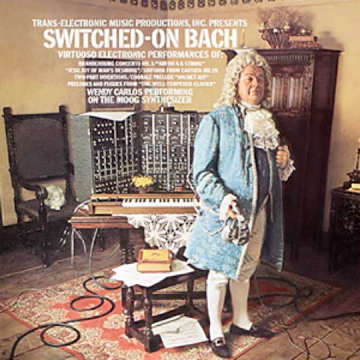
Time for a confession: the first Bach recording I ever purchased was Walter/Wendy Carlos' Switched-On Bach a synthesizer version of some popular Bach pieces released in 1968. I think I bought it in 1970. I was at the time an electric bass and six-string guitarist, recent member of several different bands and new admirer of classical music. Here is an example of the kind of arrangement found on that album:


I am reminded of this by an article in The Nation about a new book by Paul Elie. Reviewer Michael O'Donnell describes it as follows:
Classical music has experienced years of diminishing ticket sales and the indifference of young listeners and so must exploit technology, Elie believes, in order to endure. To prove as much, he lived for “a thousand and one nights” with Bach’s music on compact disc, MP3 and radio, and he emerged on the other side of the experience eager to proselytize both the music and the recording technology that captured it. Against the instinct of purists to denounce the ubiquitous cheapening of classical music in ringtones, overheated movie trailers and hip-hop songs, Elie contends:  “The more various our encounters with Bach, the more objective his genius is.”
 At the end O'Donnell comments that Elie should spend less time with recordings and more time listening to Bach live. Well, sure, but I think it would be even better to take a few lessons and learn how to play a little Bach. You don't need to be a virtuoso to experience playing Bach and it will connect you with the music in a way that no amount of listening to recordings or going to concerts will do.

But what I really want to talk about is how these kinds of disputes between people who argue for popularizing Bach by playing him on synthesizers or jazzing him up or playing him in subway stations as they recently did in New York and people who argue for more historically-informed performances of Bach are actually a kind of category mistake.

The notion of a category error comes from a 1949 philosophical inquiry by Gilbert Ryle in a book titled The Concept of Mind and it is a useful notion. To give a musical example, you might be giving an introduction to classical music to a friend by taking him to an orchestral concert. You point out the different instruments to him: those are the violins and over there are the flutes. He says, "ok, I see the violins and the flutes and the other instruments you pointed out, but I don't see the orchestra. Where is the orchestra?" He has made the category mistake of not understanding that all the instruments together constitute the orchestra.

I think that nearly all the typical disputes about Bach, or classical music generally, are plagued with category mistakes. When we talk about performing Bach on synthesizers or on harpsichord, in a concert hall or a subway platform, on a recording with digital editing or in your music room at home we are talking about the accidentals of music, not the essence of music.

I notice that much discussion of aesthetics avoids the words 'good' and 'bad' as if they were infectious. The paragraph I quote above twists around, but ends up saying that Bach's genius is "objective", which I take it means 'good'. When you play Bach you can handle a phrase well or badly. Your texture can be clear or muddy. There are a thousand things you can do that work or don't work--and by 'work' I mean are musically effective. It is this sort of thing that matters. If I want to demonstrate how a phrase should (or could) be shaped effectively, I could do so on a guitar, a piano, a synthesizer or a copy of an historical harpsichord and which I chose would be nearly irrelevant. I say 'nearly' because some qualities, like speed of decay or type of attack, could influence how I shaped the phrase.

You can deliver an effective performance of Bach in many different ways on many different instruments which is why transcriptions of Bach are so frequent and so successful. You can also deliver many different kinds of ineffective, maudlin, muddy and wobbly performances of Bach on many different instruments. This is the kind of distinction that matters: between good and bad, not between this model synthesizer and that kind of violin bow, between a performance on piano or one on harpsichord.

We admire the performances of Glenn Gould not because he had an eccentric personality or sat on a funny chair or hummed when he played or isolated himself in the studio or chose a certain editing procedure, but because he played Bach well. Really well. That's the only thing that matters.


Bach endures not because of the use or non-use of any particular technology or even musical instrument, but because his music is aesthetically powerful. This is what drives everyone from Carlos to Gould to me to play Bach and a host of others to listen to Bach.

Townsend: Suite in A major, Minuets and Gigue by J. S. Bach

Today, to end the year, I'm completing the Suite in A major by putting up the last two movements, the minuets and gigue. The recording engineer, for some reason, did not separate these tracks, though he should have, so I have to put them up together.

The minuet is a graceful, courtly dance of French origin in 3/4 time. It was adopted into the suite in the late 17th century and placed between the sarabande and the gigue. Minuets usually come in pairs and since each is a binary dance, the form is AABB (first minuet) AABB (second minuet) and finally, AB (first minuet again, this time without repeats). So the whole form is ABA with A being the first minuet and B the second. The second minuet, in the music of Lully, who popularized the dance, is often scored for a trio of instruments such as two oboes and a bassoon and so the whole structure was often called "minuet and trio". In this form, it was the only dance of the baroque suite to survive into the classical era where it became a standard part of the symphony. A lively version became the classical scherzo such as was used by Haydn and Beethoven.

The gigue is a lively dance originating in Britain where it survives to this day as the Irish and Scottish jig. In the 17th century it was adopted by composers on the continent and found a place as the last dance in the suite. It is usually in 3/8 or one of the compound meters such as 6/8, 9/8 or 12/8, though there are a couple of exceptions by Bach. I talk about one of them in this post. In Bach's hands the gigue can get rather complex at times with each half becoming semi-fugal and the second half inverting the subject of the first half. The gigue to the Suite in A major is not one of these, but a rather straightforward gigue in 6/8 time.

Time signatures like these, called "compound" are a simplification of the Medieval mensural notation. Mensuration is the relationship between any note value and the next smaller note-value. In modern notation this relationship is always duple: every smaller note is half the value of the larger note. Less abstractly, every half breaks down into two quarter notes, every quarter into two eighths and so on. In mensural notation, there are always two options: duple or triple. The breve could break down into two or three semibreves and this was indicated by the time signature. A circle indicated a triple division and a half-circle, a duple division. This latter time signature survives into modern notation and music teachers who don't know their history tell their students the half circle (equivalent to 4/4 time) is a "C" standing for "common time". Actually, it stands for "tempus imperfectus cum prolatio imperfecta"! Triple was "perfect" and duple "imperfect" to Medieval musicians.

In modern notation we have replaced these complexities with two things: meters where the subdivision is triple, not duple, we call "compound" and we think of the beat as a dotted note (divisible in three). In all other cases, we use the triplet sign of a bracket with a "3" in the middle. Inelegant, but simpler than the Medieval system.

Between 1717 and 1723 Bach was employed by Prince Leopold of Cöthen (now spelled Köthen) and this is where he wrote the six cello suites. In the clip I have included a picture of the St. Agnus Church in Köthen, which Bach attended, the first page of the manuscript of the cello suites in the hand of his wife, Anna Magdalena Bach, the opening of the first minuet and some pictures of myself. Accompanying the gigue are photos of the Bach monument in Leipzig, just outside the Thomaskirche, where he is buried, the Bach Museum and archive, also in Leipzig and the first page of my edition of the gigue.


Townsend: Suite in A major, Sarabande by J. S. Bach

The next movement in the Suite in A major (transcribed from the First Cello Suite in G major, BWV 1007) is the Sarabande. As I mentioned earlier, the sarabande, one of the four core dances of the Baroque suite, originated in Mexico and first appears in Europe in guitar tablature. Originally it was a sexy and vigorous dance which led to its being banned in some places. The earliest versions are just strummed chords. Unfortunately, there seem to be no examples of the early sarabande on YouTube. But here is a later example, by Johann-Anton Logy:


As time went on, the sarabande was slowed down and became the heart of the suite with the most expressive depth. There are a few sarabandes where Bach has written out ornamentation. For most he has not. This could mean either that he thought it was unnecessary or just that it was unnecessary for him to write it! Much of the time, I think Bach does not need added ornaments. But I have put in a few in this sarabande. There are only a couple of portraits of Bach from his lifetime, both of which I have already used, so for this clip, I have put in an 18th century etching of the Thomaskirche Square and the first page of the First Violin Sonata, in Bach's original manuscript. Then the opening of my transcription of the sarabande and some photos of me.


Townsend: Suite in A major, Courante by J. S. Bach

This is the third movement of the Suite in A major by J. S. Bach, which is my transcription of the First Cello Suite in G major, BWV 1007. Here is the first movement and here is the second.

There are only two basic forms used in the Baroque suite: the prelude and the binary dance form, though occasionally one runs into a rondeau such as the Gavotte en rondeau from the E major violin partita. The two basic forms could be compared to prose and poetry in literature. The prelude is a very free kind of form without repeated sections. It tends to be one large gesture. Sometimes it is just a series of arpeggiated chords, other times it can resemble an Italian concerto movement. But the form of the prelude always contrasts with the dance movements that follow in its openness and free structure. It is like prose, it just flows.

The rest of the suite is nearly always a series of dances, the four 'core' dances, the allemande, courante, sarabande and gigue with galanteries or optional dances often inserted between the sarabande and the gigue. All these dances have the same form: AABB, that is, they are in two halves, the second usually a bit longer, and each half repeats. Performers often leave out the repeat of the second half, but in my recording, I repeat both halves. Harmonically, the first half usually moves to a cadence on the dominant (in a minor key, often on the relative major). So in this suite, in A major, the first half of every dance movement has a cadence on E major. In the second half, the music returns to the tonic and ends with a cadence on A major. Every movement does exactly the same thing! But how the music goes to the dominant and returns to the tonic is different every time! And Bach and every other Baroque composer did this in hundreds and hundreds of dance movements. Bach just did it better.

The clip today is of the third movement, the courante. This courante is in the Italian style, quick and without the hemiolas one finds in the French-style courantes. To accompany the performance I have included a portrait of Bach as a young man (disputed by some), an etching of the Thomaskirche in Leipzig where Bach spent most of his career as cantor, the beginning of my edition of the courante and some photos of me.


Townsend: Suite in A major, Allemande by J. S. Bach

I managed to put up the first movement of this suite yesterday without actually mentioning anything about the music! Let me fix that. The instrumental suites of Bach, whether for keyboard, lute, violin or cello, are multi-movement works inspired largely by the French style. German musicians of the 17th and 18th centuries were synthesizers, taking what they liked and admired from both French and Italian models. Bach learned a great deal about harmonic clarity and drive from the model of Vivaldi, but for the suite, the model was J. J. Froberger (1616 - 1667), a 17th century keyboard composer whose Dix suittes de clavessin, published after his death, were the model for the instrumental suite for every German composer afterwards.

The core of the suite was four courtly dances in the French style: the allemande (a sober dance in duple time, as the name tells us, originating in Germany), the courante (a quicker courting dance in triple time that comes in both Italian and French forms, the French being a bit slower and with hemiola effects), the sarabande (originating in Mexico as a sexy sensual dance and first found in Europe in guitar tablature, it was slowed down considerably and made more dignified with the accent on the second beat) and the gigue (imported from England and Ireland, a quick dance in compound time, usually 6/8). This international set of dances became the core of the baroque suite. Added to these four dances was the prelude, often in the style brisé or 'broken' style of the lute, meaning that it was largely chordal with the chords broken up into interesting arpeggios as we heard in the prelude yesterday. Another addition, usually between the sarabande and the gigue, were dances known as galanteries, that could be a pair of minuets, or a single air, bourrée, gavotte or chaconne. Oddly, this feature of the Baroque suite was the only one that survived into the classical period where the standard arrangement of the multi-movement instrumental piece was the sonata with four movements consisting of a quick sonata-form movement, a slow movement, a pair of minuets and a rondo.

Here is the allemande to the Suite in A major. I have included a portrait of Bach that he had done in Leipzig when he was applying for admission to a learnéd society, a photo of the "Bachhaus" in Köthen where he lived from 1717 to 1723 and composed the suites for solo cello, then there is the opening of my edition of the suite and some photos of me.


Townsend: Suite in A major, BWV 1007 by J. S. Bach

One of the shortcomings of the classical guitar is that it has not attracted compositions by the great composers. There is no Beethoven, Mozart, Haydn, Brahms, Bartok or Shostakovich for guitar. Instead, up until the First World War, what we have are "guitar composers", that is, composers who are guitarists and write primarily for guitar. They include Robert de Visée, Francisco Corbetta, Fernando Sor, Dionisio Aguado and Francisco Tarrega--none of them renowned composers outside of the guitar world. Then, between the First World War and the Second World War, the remarkable performing career of Andrés Segovia inspired a host of good composers to write for guitar. These included Manuel Ponce of Mexico, Joaquin Turina and Federico Moreno Torroba of Spain, Mario Castelnuovo-Tedesco of Italy and many others. Unfortunately, none of these were first-rank composers either, though they produced a lot of quite good music. After the Second World War, another guitarist set out to inspire composers to write for his instrument and he succeeded in attracting some quite important names, mostly from his own country, Great Britain. The guitarist was Julian Bream and as a result, there is a lot of excellent repertoire by Benjamin Britten, Peter Maxwell Davies, Lennox Berkeley and Hans Werner Henze and others. His partnership with the outstanding tenor Peter Pears also resulted in a lot of excellent music for voice and guitar, by Britten and Berkeley in particular.

In order to beef up the repertoire, guitarists have long looked to music written for other instruments. An early example is Luys de Narvaez' transcription of a chanson by Josquin des Prez for vihuela, a predecessor to the guitar. Robert de Visée transcribed an overture by Jean-Baptiste Lully for both baroque guitar and lute. Here is a performance:


Tarrega transcribed music by Chopin for guitar. In the 20th century the practice of transcription took off in a big way and guitarists looted the repertoire for lute, harpsichord and piano to adapt to their instrument. They were so successful that some pieces originally for piano, like "Asturias" by Albéniz, are now better-known on guitar. Segovia was a particularly successful transcriber and it is his version of "Asturias" that is most often played today. Another very successful transcription was his adaptation of the famous Chaconne from the D minor violin partita. He transcribed a lot of other music by Bach as well. The most promising source of repertoire suitable for the guitar turned out to be the music for solo violin and cello. Bach also wrote music for lute (though it was likely composed not for an actual lute, but rather for the keyboard instrument that sounded rather like a lute called the "lautenwerk"), though the textures are sometimes too thick to be comfortable on guitar.

One of the most successful transcriptions, made by John Duarte rather than Segovia, was of the first cello suite, originally in G major, but transcribed in D major. I started out to work on this with José Tomas when I studied with him in Spain. He had some misgivings about the Duarte transcription. The problem is that when you put the whole suite up a perfect fifth, from G to D, it sounds rather thin and in need of a bass line. So Duarte supplied one. The only problem with that is that neither Duarte nor anyone else is really capable of writing a bass line that would do justice to a piece by Bach. Tomas, who played an eight-string guitar going down to a low C, played through part of the suite in the original key and convinced me that it had much more sonority down low. When I got time, I sat down and figured out that on a six-string guitar the best option was to go as low as possible. With the sixth string tuned to D, that meant A major. So I transcribed the whole suite in that key. Apart from a couple of notes suggested by Oscar Ghiglia in the gigue, I didn't feel the need to add anything!

UPDATE: I forgot to mention that Pepe Romero followed exactly the same procedure in his transcription of the Third Cello Suite which he plays in D major, up a tone from the original C major--and with virtually no added notes.

It is an interesting question why transcribing Bach is often successful, but we avoid transcribing Beethoven, Mozart and all those other great composers. I think it is because Bach's music is not so tied to whatever instrument he originally wrote for. If you can play the notes, then the piece is going to come across. But we shudder to think how playing Beethoven's Moonlight Sonata on any other instrument would distort the effect.

I will put up the whole suite, which is in six movements, but for today, here is the prelude:


This suite is included in my book of Bach transcriptions, now out of print. I am thinking about re-issuing it as an e-book through Amazon. Here is the link to the original edition.

Merry Christmas!

Seasons greetings to all my readers all over the world and best wishes to you all. I've mentioned before how impressed I am that this blog is read in so many different countries--and so many of them non-English-speaking. Music may not be a language, exactly, but it is pretty universal. Thanks to you all for reading the blog and especially for commenting. There will be lots of things to explore and discuss in the new year. For today, here is some appropriate music. The first performance of Bach's Christmas Oratorio (put together with new text from a number of previous compositions) was Christmas 1734. The second performance was not until Christmas 1857, one hundred and twenty-three years later! Wikipedia has quite a good article on the piece here.


Musical Form, Part 2

Yesterday I put up a post about musical form that mostly talked about how melody can be used to structure a piece. This merely scratched the surface, of course as there are many, many ways that I didn't mention such as the way a melody can be transformed in the course of a piece so that it not only provides a unifying element, but also helps to push the piece forward. The 19th century particularly explored this idea.

But I'm not going to talk about melody today, instead, I'm going to merely scratch the surface of how harmony is used in musical form. Everyone knows what you mean when you use the word melody but harmony is a word with complex meanings. Like 'melody', it comes from the ancient Greek: ἁρμονία (harmonía) which meant joining or fitting together. We use it in a very general way to mean the vertical aspect of music: everything relating to notes sounding together. But there are more specific meanings as well. If you take a course in university in the music department called "harmony" it is going to be about the system of tonal 'grammar' that was used in Western music between 1600 and 1900. This system looked at different chords as being functional, i.e. they were part of a web of tension and release that was used to structure the flow of music. For example, a lot of recent music is based on drones, long-held notes and chords, and for that reason is not 'harmony' in the strict sense as there is no harmonic function. Here is a recent song by Paul Simon that is almost completely without harmonic function. The verses are all one unchanging riff and, therefore, harmony. The contrasting chorus mainly contrasts by dropping the riff and there is a hint, no more, of a harmonic change. But it is minimal. A theorist would say that moving to neighboring harmonies and then back is actually just extending the tonic.


To see how harmony works you could do no better than to look at some music by J. S. Bach who is admired as being probably the greatest master of harmony. Here is a very simple piece by him, the first minuet from the Partita No. 3 for solo violin. Just click to enlarge.


This piece is in E major, which means, in terms of functional harmony, that it is going to begin with an E major harmony and end with one. Later on Beethoven created quite a stir when he began pieces with something other than the tonic--usually the dominant. Ah yes, 'tonic'. The tonic chord or harmony is the one built on the key note, in this case E. By "built on" I am referring to how chords are constructed. You build a chord by taking every other note in the scale. For example, the E major scale goes E, F#, G#, A, B, C#, D# and E. A tonic harmony, starting with E, would be E, G# and B. Every other note. Simple. Here is the E major scale and three important harmonies derived from it: the tonic, on the keynote, the subdominant, on the 4th note, A, and the dominant, on the 5th note, B:
The basic layout of this minuet and virtually every other dance movement from the Baroque era is Tonic -- Dominant -- Tonic. But there are thousands of ways of going from tonic to dominant and back! One more thing before we go to the piece: as you will realize if you look back at that scale, you can build a chord on every note of the scale. The three chords I picked out and labelled, tonic, subdominant and dominant, are the main members of little families of chords. I say that because every chord has related chords that it shares notes with. The closest relationship is when two notes are shared. For example, the tonic, E, G# and B, shares two notes with the mediant: G#, B and D#. These two chords are related. Similarly, the subdominant, A, C# and E, shares two notes with the submediant, C#, E and G#. Mediant and submediant are labels for other notes of the scale. You want the whole list? OK:

  1. tonic
  2. supertonic
  3. mediant
  4. subdominant
  5. dominant
  6. submediant
  7. leading tone
All right, now let's look at the beginning of the minuet. Click to enlarge:

The first two measures are just as Bach wrote them. The next two are my simplification of the first two showing just the harmonies. It starts with the tonic, of course, and the next chord is the dominant. Actually, just part of the dominant, without the lowest note. Then we get that lowest note, B, but over it is a G# so what that harmony actually is, is the mediant. Then the next measure is the submediant. Yes, lots of stuff in just a couple of measures. I won't go through every measure because I just want to give you a taste of how harmony works. But to round things off, let's look at the ending. Click to enlarge:
The supertonic is part of the subdominant 'family' as it shares two notes and the mediant is part of the tonic 'family'. So the basic harmony of the last two measures is subdominant, tonic, dominant, tonic. Bach uses other family members to make it more interesting and smooth the movement of the voices. Now let's listen to the whole piece. Here is Arthur Grumiaux playing both minuets (they usually come in pairs).


The minuet we have been looking at is less than a minute of music without the repeats! But in that minute Bach has a wide range of harmonies, all carefully calibrated to move us toward the dominant, which is where the first half ends, and then move us back to the tonic. This is one way of using harmony to structure musical form. From about 1600 to 1900, this was the predominant way of putting a piece of music together.

What is Musical Form?

Over a year ago I wrote a post on Form in Music that inspired some brilliant comments about the role of rhythm in jazz. It also inspired an email from a friend who said he didn't understand any of it! That post was intended to be the first of several on musical form, but I didn't follow up. My learned anonymous commentor made some excellent points and it is well worth going back and reading the whole post and the comments.

What I want to do here is restart the discussion by looking at form from an entirely different angle. In the previous post I talked about the basic structure of songs as that is something many people are familiar with. Today I want to take a different tack. There are three fundamental aspects of music: melody, harmony and rhythm. Every piece of music is a structure in which any one, two or all three are present--even John Cage's 4'33 which has a structure consisting only of rhythm, i.e. time. The form of a piece of music, that is, the articulation of it in time, is created by using any one, two, or all three of these aspects. That is so abstract that you are probably either scratching your head or rolling your eyes! Let me make it more concrete.

Let us imagine a simple musical context: a drumming circle. In Montréal when I lived there a group of drummers used to meet on Sunday afternoons in the park and drum together. Someone would start a simple beat then others would add various subdivisions and syncopations of the beat until a satisfactorily dense texture was created. This might go on until everyone was tired of it and then stop. Or, if it started to flag, someone might try and start an entirely new pulse, thereby launching a new section. If this just goes on until it peters out, then you have the form A (the first beat) followed by B (the second beat). If everyone then went back to the first beat then the form would be ABA. This is the very simplest musical form. Do something, then do something else, and if you are clever, then you return to the first thing again.

But the very first kinds of written down music in the West are both more complex than this but also even simpler. One of the earliest kinds of music in the West consisted of singing the psalms. Singing made the text a more sacred utterance. One person would first sing a few notes to establish the pitch, this is an "intonation", then the rest join in on a "reciting tone", just a repeated note. This reciting tone can go on as long as needed for the text. It can be punctuated if needed to indicate a division in the text. This punctuation was called a "fluxus". Then you return to the reciting tone. To end, there is another few notes that fall in pitch, called a "cadence" which means falling or "cadere" in Latin. Don't mix this up with the cadence in common practice harmony, which refers to a structure of two or more harmonies.

I suppose that what I have just described is very roughly ABA, but it is really a kind of musical prose, where the form is very loose and while originally there is just enough melody to encourage people to sing a text, the tendency over time is to add more and more decoration. Here is an example of this kind of psalm setting, one of the early favorite texts "Justus ut palma" from Psalm 91:


This kind of form is so loose that it is almost impossible to describe. A lot of music composition consists in giving form to what was originally formless. So a meandering melody like this, only organized in terms of a reciting tone and a final tone, composers are going to replace with a melody with a clearer structure. I'm not going to work my way through music history here, instead, I'm just going to jump to a different kind of melody that is very organized. Here is the original subject from the Art of Fugue that Bach will transform in various ways:

This subject is both very simple and highly organized. It is the very opposite of the loose, meandering kind of melody found in Gregorian Chant. The first two measures state the tonic harmony, D minor, as simply as possible. Then the next measure states the dominant harmony. The last measure allows for ambiguity as it can be harmonized in different ways, but it returns to the tonic at the beginning of measure five. Notice that there are two measures of arpeggiation followed by two measures of a scale. Notice also that the rhythm speeds up over the four measures. This extremely simple, highly organized theme will serve as the material with which Bach will construct a whole series of fugues, fourteen in all, and four canons. Here is a performance of the first fugue, which uses the theme exactly as I have given it above:


You will notice that as each voice enters, it does so with the same theme. This is one way of structuring a piece of music with melody. Though, of course, as soon as you have more than one voice, then the harmonic structure becomes hugely important as well. But let's leave that aside for the moment and just note how this simple melody ties the whole piece together. You can look at the structure of fugues in various ways, but the most salient aspect is that theme: it is what generates the structure, that is, the form.

In a more mechanical way, the contemporary composer Steve Reich has done something very similar: use a single theme to generate the structure of a piece. He does it by creating a short theme for piano and then, with two pianos playing that theme together, one "slides" ahead rhythmically bit by bit, a process he calls "phasing". Here is what that sounds like:


UPDATE: Here is a complete version of the piece:


In between the basic subdivisions, i.e. when the notes don't "line up", there is considerable rhythmic tension that is released when the two pianos slip back into alignment,  though, a different alignment! The piece ends when the whole set of alignments has been traversed and the two pianos are back in the original relationship.

What is interesting about this is that he uses only a simple rhythmic device to generate the whole piece from that original theme.

There is a lot more to say about how musical form can be created, but I'll save it for next time!

The Latin American Prelude and Some History

Last week I posted a performance of myself playing the Prelude No. 4 for guitar by Villa-Lobos. I'm going to put up some more preludes by another Latin American composer soon, but I want to say something about form first. The pre-lude, literally the thing you do before you play, started out in the 17th century as a couple of chords just to check the tuning for lute-players. I went into that in some detail in this post. Given that origin, the earlier preludes tended to be fairly simple arpeggiations. Bach, of course, made them a lot more complex, but the basic idea of a single, fairly simple, texture throughout, remained. Let me just give you some examples. First, a 17th century unmeasured prelude by Louis Couperin:


Other preludes by Louis Couperin extend into fantasia-like pieces. Here is a very typical lute prelude by S. L. Weiss based on a simple arpeggio:


And here is the kind of prelude Bach liked to write. There is but a single musical idea and it tends to be some sort of arpeggio:


Chopin, the next composer after Bach to really take the prelude seriously, followed this basic idea but with one important addition. Alongside a kind of arpeggio pattern he placed a touching and expressive melody:


But the idea of a prelude as being essentially a piece without contrasting sections was preserved. The first guitar composer to write preludes was Manuel M. Ponce, probably in the 1920s or 30s. He wrote twenty-four preludes, more or less emulating the example of Chopin. They are mostly very short pieces, less than a minute long, and each explores a single idea. Here is the Prelude in F# minor (they have different numberings depending on the edition), one of the longest:


Then came Villa-Lobos who wrote his five preludes for guitar slightly later, in 1940, with quite a different model. Though Bach was an important influence, when it came to his preludes the popular music of Brazil was just as important. All of his preludes are in at least two different sections with two different tempos, themes and moods. Take the Prelude No. 2, for example: short arpeggios with appoggiaturas and occasional scale passages are found in the first section, while the second section, piu mosso, uses a single arch-like arpeggio throughout. Then the first section returns for a basic ABA form. Here it is a live performance with John Williams. Sorry about the funny sound, but even with that, I think you would like to hear this version:


With the exception of the Prelude No. 5, that has three contrasting sections (ABCA), all the Villa-Lobos preludes rely on two contrasting ideas in different tempi. Except for the Prelude No. 3, that repeats ABAB, they are organized as ABA.

So that's a little history of the prelude with special attention to preludes written for guitar in the 20th century. This will be an introduction to the next group of recordings I am going to post. I am going to put up the Five Preludes by Máximo Diego Pujol (b. 1957), the Argentinian guitarist and composer. As one might expect, a major influence on his music is that of Astor Piazzolla, the great tango composer.

Bach: Partita No. 6, Gigue

The last of Bach's six keyboard partitas is a wonderful piece of music, challenging to both the performer and the audience. One of the most interesting challenges is the gigue, the last movement. As everyone knows, gigues are always in compound time, either 6/8, 9/8 or 12/8. Well, ok there are a few exceptions. The gigue to the first partita is notated in that "C" signature that ill-educated music teachers insist on calling "common" time, when it is actually a hold-over from the Medieval modal time signature tempus imperfectus meaning duple, as opposed to triple time. But, as each beat contains three eighth notes, it is easy to see that what you actually play is 12/8, even though Bach doesn't indicate any triplets. The Fifth French suite gigue is in 12/16, but that is the same thing, more or less, as 12/8. The Third Partita is in an entirely normal 12/8 and the Fourth Partita in a hardly unusual 9/16. The Fifth Partita is in the unexceptionable 6/8 that most gigues are.

But the Sixth Partita, well, that's an entirely different kettle of fish. This is a particularly recondite gigue cast as a fugue with a chromatic leaping subject and the second half uses the same subject in inversion. But the time signature! It's like two "cut" time signatures facing one another, or like a circle with a slash. Like this, but with the slash vertical, not at an angle: ∅ What could this possibly mean? Not too surprisingly it is also derived from Medieval metric notation. The circle with a vertical slash stands for proportio dupla sometimes called diminutio simplex. From the 14th to the 16th centuries this meant that the correct rhythmic reading of the notes would be two short notes making up a long, as opposed to three short notes making up a long. It seems as if Bach is using a very, very old-fashioned metric signature to tell the player that, yes, this is a gigue all right, but it is a gigue in duple time! Very odd, since gigues are, as I said, always with a triple subdivision. Just not this one. It still sounds, oddly, like a gigue ... in duple time. How strange that Bach would choose to end, not just the set of six partitas, but the very lifespan of the Baroque keyboard suite itself, with such an unusual movement.

For an entirely different reading of this whole time signature issue, have a look at this essay which relies more on how this kind of signature was interpreted in the 17th and 18th centuries.

Now, for a couple of performances. The first is by Murray Perahia and he plays the rhythms as they appear in the score.


The next is Trevor Pinnock interpreting the rhythms as indicating triplets in the way suggested in the essay I just linked to. Of course doing this involves quite a lot of tinkering! How much tinkering, you ask? Well this chart from the essay illustrates one scholar's suggestions. On the left is the original time signature and rhythms. UPDATE (correcting left to right): On the right is the proposed "tripletization" with a 24/8 time signature and the rhythms adapted appropriately:


Now let's have a listen to what that sounds like:


Which do you prefer? I lean towards the duple version because I think it is more interesting of Bach to have written a truly duple gigue than that he wrote one that looks like a duple gigue, but one you can, with a lot of tinkering, turn into a triple gigue. On the other hand, isn't it even more fascinating that both of these possibilities exist?

The Socratic Interpretation of Music

At nearly the beginning of Western thought stands the enigmatic figure of Socrates (469/470 BC - 399 BC). One indicator of his influence is that some law professors to this very day use the "Socratic method", based on asking questions to eliminate faulty hypotheses, in their teaching. Oh, and scientific method is also based on Socrates. In Plato's Apology, Socrates' philosophical life began when his friend Chaerephon asked the oracle at Delphi if anyone was wiser than Socrates; the Oracle responded that no-one was wiser. Socrates, skeptical of how this could be, proceeded to test the riddle by approaching men considered wise by the people of Athens—statesmen, poets, and artisans—in order to refute the Oracle's pronouncement. But Socrates concluded that, while each man thought he knew a great deal and was wise, in fact they knew very little and were not wise at all. Socrates realized that the Oracle was correct. While so-called wise men thought themselves wise and yet were not, he himself knew he was not wise at all, which, paradoxically, made him the wiser one since he was the only person aware of his own ignorance. Knowing that one does not know is the highest wisdom.

I have played Bach for over forty years on guitar. Indeed, the piece that was probably more influential than any other in causing me to study classical guitar in a disciplined way was the Chaconne from the D minor Partita for violin. Andres Segovia transcribed it for guitar and ever since, it has been at the pinnacle of the guitar repertoire. Let's have a listen to John Williams. This is from a concert in Toronto in 1987 and I think the quality of the performance more than makes up for the quality of the sound.


Ironically, I have never quite gotten around to playing the Chaconne in concert, though I have played several lute and cello suites and many other individual pieces by Bach. In addition to giving hundreds of performances of the music of Bach, I have also read twenty or so books on Bach and an equal number on Baroque performance practice. I have also, of course, listened to dozens if not hundreds of other performers' interpretations of Bach. But I have never quite felt confident about how I play Bach and a couple of years ago I said to a friend of mine, who has also played Bach for forty years or so that "I don't know how to play Bach." She looked at me with frank astonishment! Why would I say that? Bach poses big challenges to a performer. Big challenges. I think that I had gone through a period of real growth in my musical understanding, perhaps sparked by a greater focus on my own composition, and as a result, had come to feel that the way I had played Bach was perhaps not adequate. Mind you, I probably was starting to feel this about most performances of Bach!

So for me, the way forward, was to sweep aside all the underbrush, all the accumulated detritus of Bach interpretation and look at it with really fresh eyes. Step one, admit that you know nothing! I don't think most performers realize how much the way they play Bach is piggy-backed on the way generations of performers have played Bach. There are few that really make a fresh start. On the guitar, John Williams is one. But the greatest renewed approach to Bach interpretation is, of course, Glenn Gould, whose 80th birthday would have been yesterday. Let us listen to a whole bunch of his re-thought from scratch J. S. Bach. The Well-Tempered Clavier, Bk 1:


The unexamined interpretation is not worth playing!

Musical Ciphers

The fancy name for this is gematria from the Hebrew, but it could also be derived from the Greek geometria. In either case it refers to assigning numerical values to letters or phrases. Here is the Wikipedia article. In music, it is the practice of associating musical notes with letters so the music, or even the notation, can contain a message. Another method used in music was number symbolism in which the number of notes can be symbolic. Guillaume Dufay offers a couple of examples of this. In his motet Vasilissa ergo gaude written to celebrate the marriage of the daughter of an Italian nobleman, Cleofa Malatesta, to the son of the Byzantine emperor Manuel II the total number of notes in the motet are 800 which in Medieval numerical symbolism means 'eternity'. The actual symbolic number is 8, but you can't write much of a piece with only eight notes! Here is the motet:


Dufay would also sometimes sign his name in the score by writing "Du" followed by the note "fa". But the great master of number and note symbolism was J. S. Bach and the most famous instance was his signing his name to the last piece in his Art of Fugue. In German, the way the notes are pronounced is different than in English. For historical reasons, Germans pronounce B flat as "B" and B natural as "H". Therefore Bach could write his name in notes: B flat, A, C, H. Here it is as it appears in the last (unfinished) piece in the Art of Fugue:

And here is that fugue, Contrapunctus XIV:


It ends abruptly, incomplete... The BACH cipher appears at the 9:38 mark in the recording. This is a triple fugue. It starts with a subject derived, as are all the subjects in the Art of Fugue, from the original theme. Then, after a substantial fugue on that theme, a new theme in eighth notes is introduced, and in this second part, the theme from the first part returns. Then, after a full cadence, the new theme, BACH is introduced and a third fugue begins. The plan would have been to then reintroduce both of the other themes, but it remains incomplete. With most pieces by great composers left incomplete, someone always steps in to complete it. The most famous example is the Requiem of Mozart, completed by his student Süssmayr. Yes, there are completions for this piece too, but the suspicion always is that no-one alive is quite qualified to complete it. So it is often, as above, left incomplete... Here is the Wikipedia article on the Art of Fugue. There are two entries of the BACH cipher that are backwards, 'cancrizans' in musical parlance. Here is one of them:
This is quite similar to another famous cipher used by Dmitri Shostakovich. Taking advantage of the fact that in German E flat is pronounced "es", he writes his own name in notes this way: D S C H. Here it is in notes:
Those intervals differ from H C A B by only one note, the last one. This theme permeates all of Shostakovich's String Quartet No. 8 and was also, appropriately, used on his tombstone:

Click to enlarge

Here are the first and second movements of the string quartet. That four note theme is presented as a fugue in the very beginning:


Going back to Bach to close, he also used number symbolism as Dufay did. On his own printed copy of the Goldberg Variations he jotted down fourteen canons based on the bass of the theme. Why fourteen? It is the number of his name: B = 2, A = 1, C = 3 and H = 8. Total = 14. This was only discovered in the 1970s! You might also recall that the Art of Fugue also has fourteen fugues? And there may be more symbolism that we haven't noticed yet. One scholar has pointed out that the Mass in B minor seems to have some interesting numbers in it. The only music in the mass that is repeated is the chorus Gratias agimus tibi from the Gloria which returns as the Dona nobis pacem to end the piece. The theme of these two sections begins with the notes D, E, F#, G, or, numbering the notes, not in the key of the movement (D major), but as if they were in C major, we get 2 3 4 5. Now this may be of no significance whatsoever, but, as a matter of fact, there are precisely 2345 measures in the mass as a whole. Hmmm. Here is that Dona nobis pacem:


Support : Your Link | Your Link | Your Link
Copyright © 2013. Free Music Learning Center - All Rights Reserved
Template Created by Creating Website Published by Mas Template
Proudly powered by Blogger